You’ve been reading the Bible your whole life. You know the stories. You’ve heard the sermons. You’ve memorized the verses.
But what if you’ve been missing the point the entire time?
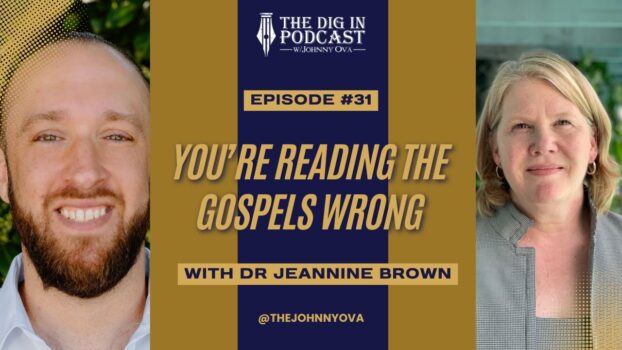
In this episode of The Dig In Podcast, Dr. Jeannine Brown, Vice Chair of the NIV Bible Translation Committee and David Price Professor at Bethel Seminary, sits down with Johnny Ova to drop a bombshell on how most Christians engage Scripture. After 25+ years training pastors and literally helping translate the Bible you read, Dr. Brown pulls back the curtain on why our fragmented approach to the Gospels robs us of the themes, the tension, and the narrative power that Matthew, Mark, Luke, and John worked so hard to communicate.
If you’re a pastor, Bible study leader, seminary student, or just someone who wants to actually understand what you’re reading, this episode will rewire how you see Scripture.
The Problem Nobody Talks About
Here’s the uncomfortable truth: we’ve been trained to read the Bible in pieces. A verse for your morning devotional. Eight verses for Sunday’s sermon. A parable for small group. A miracle story for the kids.
Dr. Brown calls this out directly in the episode. She says the most common mistake she sees after decades of training pastors is that we’re content to take little parts of the Gospel and stop there. We never ask what it would look like to read the whole thing.
And that matters. A lot.
Because when you only read fragments, you miss the themes that the Gospel writers were building across entire books. You miss the character arcs. You miss the callbacks to the Old Testament that would have hit first century audiences right between the eyes.
Dr. Brown puts it bluntly in the episode: “Pretty soon you have to get your head out of the weeds and look up and say, what am I missing if I don’t see the whole vista?”
Want to hear her full breakdown of this problem and how to fix it? Watch the episode.
What the Early Church Did Differently
One of the most fascinating moments in this conversation comes when Dr. Brown shares what early Christian gatherings actually looked like.
She cites Justin Martyr from around 156 CE, who wrote that in Sunday gatherings, the Gospels and Old Testament writings were read “as long as there is time.”
They didn’t stop after eight verses. They kept reading. Chapters at a time. Maybe an entire Gospel in one sitting.
Think about that. The first Christians who received Matthew’s Gospel didn’t want to go home in the middle of the story. They wanted to hear how the whole thing fit together.
Dr. Brown breaks down why Matthew’s Gospel in particular lends itself to extended reading, with built-in starting and stopping points that most modern readers never notice.
She walks through this in detail during the episode. You’ll want to catch it.
The 77 Times Connection You’ve Never Heard
Here’s a taste of what narrative Bible reading actually looks like in practice.
In Matthew 18, Peter asks Jesus how many times he should forgive someone. Peter throws out seven times, probably feeling pretty generous. Jesus fires back: “Not seven times, but seventy-seven times.”
Most sermons stop there. Forgive a lot. Got it. Moving on.
But Dr. Brown points to something buried in Genesis 4 that changes everything. A guy named Lamech, a descendant of Cain, boasts to his wives that if Cain is avenged seven times, then Lamech will be avenged seventy-seven times.
Same two numbers. But Lamech is talking about revenge spiraling out of control.
Jesus takes those exact numbers and flips the script. Where Genesis 4 launches a cycle of escalating violence, Jesus launches a cycle of escalating forgiveness.
Dr. Brown calls this one of the most stunning Old Testament connections in Matthew. And most people have never heard of it because they don’t read narratively.
She goes deeper on this in the full episode, including why this connection rarely shows up in scholarly lists of allusions.
Inside the NIV Translation Committee
Dr. Brown currently serves as Vice Chair of the NIV Bible Translation Committee. That means she’s one of the people deciding how the Bible you read gets worded in English.
In this episode, she pulls back the curtain on that process and shares how reading the Gospels as narratives actually influences translation decisions.
She gives a specific example from Matthew 8:7 that will make you rethink a passage you thought you understood. Most translations render Jesus’s response to the centurion as a statement: “I will come and heal him.” But the NIV puts it as a question: “Shall I come and heal him?”
Why does that matter? Dr. Brown explains how the characterization of Jesus across Matthew’s entire narrative influenced that decision. When you read Jesus’s interactions with Gentiles throughout the Gospel, a pattern emerges that supports the question reading.
This is the kind of insider insight you only get from someone who sits in those translation meetings. Watch the episode to hear her full explanation.
The Disciples Have “Little Faith” and That’s the Point
Dr. Brown’s doctoral dissertation focused on the disciples in Matthew’s Gospel. What she found challenges a lot of assumptions.
The disciples in Matthew are characterized five times as having “little faith.” Not no faith. But not enough faith either. In Matthew 17, Jesus tells them that even faith the size of a mustard seed would have been sufficient. They didn’t have it.
So why does Matthew portray the Twelve this way?
Dr. Brown argues that this characterization does something powerful for readers. We identify with the disciples because they follow Jesus and get some things right. But we also pull back from them when they fail because we know better. We know Jesus is going to Jerusalem to die. We know that’s a good thing.
The result? We cling to Jesus more tightly. We realize that even when disciples fail, Jesus remains faithful. The story points us to him, not to our own performance.
Dr. Brown breaks down specific passages that show this pattern. Catch the full conversation to hear her analysis.
How Pastors Should Prepare Sermons Differently
If you preach or teach the Bible, this episode will change your preparation process.
Dr. Brown shares how she trains seminary students to read whole sections of Scripture rather than just the passage they’re preaching on. One assignment requires students to analyze Matthew 21 through 22, about 90 verses, and figure out how to preach it in just three or four sessions.
They can’t just work through it verse by verse. They have to think thematically.
She also has students create visual diagrams of Luke’s travel narrative, which spans 12 chapters. They have to map out plot, themes, and sequence all at once.
The result? Students start seeing connections they never noticed before. Themes pop out. The Gospels come alive.
She gives practical advice for pastors in the episode, including how to approach familiar passages like the feeding of the 5,000 with narrative eyes.
What You’ll Learn in This Episode
This conversation covers serious ground:
- The most common mistake people make when reading the Gospels and how to fix it
- How the early church actually experienced these texts (hint: they read way more than we do)
- Why ancient biographies were arranged by theme, not just timeline, and why that matters
- How to spot themes running across an entire Gospel
- The “little faith” pattern in Matthew and what it teaches us about discipleship
- Stunning Old Testament connections hiding in plain sight
- How narrative context shapes NIV translation decisions
- Practical steps for pastors who want to preach with more depth
Dr. Jeannine Brown is one of the most credentialed New Testament scholars in the world. She sits on the committee that translates the NIV. She’s trained pastors for over 25 years. She’s written commentaries on Matthew that scholars actually use.
And she’s sharing insights in this episode that will change how you read your Bible.
Watch the full conversation now.
Connect with Dr. Jeannine Brown:
Bethel Seminary Faculty Page: https://www.bethel.edu/academics/faculty/brown-jeannine
Her Books on Amazon:
The Gospels as Stories: https://a.co/d/78cTowp
Scripture as Communication: https://a.co/d/bPbqnO7
Philippians (Tyndale Commentary): https://a.co/d/2cWn890
Subscribe and follow The Dig In Podcast:
YouTube: https://www.youtube.com/@thejohnnyova
Get Johnny’s book, The Revelation Reset:
https://a.co/d/hiUkW8H