Most Christians have never heard the word Targum. That gap is not your fault. But it might change everything about how you read the Gospels.
There is a 2,000 year old tradition sitting beneath the surface of the New Testament. It shaped the parables of Jesus. It informed his understanding of the kingdom of God. It was part of the controversy that led to his crucifixion. And for most of Christian history, it was almost completely ignored.
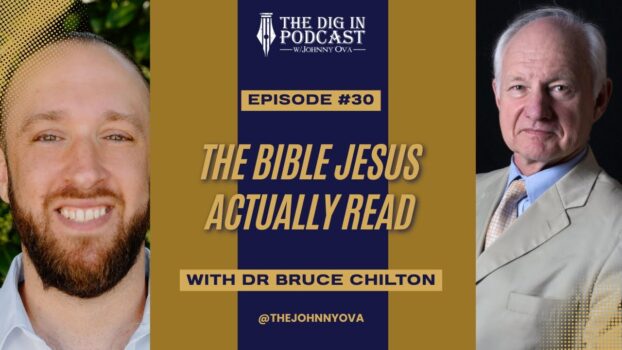
In this episode of the Dig In Podcast, I sat down with Dr. Bruce Chilton, who holds his PhD from the University of Cambridge and has authored over 50 books. He produced the first critical commentary on the Isaiah Targum and was part of the first team in history to translate all of the Targums into English. What he shared rewires the way you read scripture.
Here is what you need to know.
What Is a Targum?
The word Targum simply means translation in Aramaic. But calling it a translation undersells what it actually was.
By the first century, the dominant spoken language in the land of Israel was no longer Hebrew. It was Aramaic, inherited from the Persian Empire that had ruled the entire region. Most Jewish people living in Galilee during the time of Jesus could not read. Many could not understand Hebrew at all.
So when people gathered in synagogue, they would first hear scripture read aloud in Hebrew. Then someone would stand up and deliver the same passage in Aramaic entirely from memory. Not from a scroll. From memory. The distinction between the written word and its translation had to remain clear.
These Aramaic renderings are what we call the Targums. And they were not straight translations. They were interpretive paraphrases. They expanded the text. They introduced fresh theological ideas. They sometimes made a passage considerably longer than the original Hebrew.
Jesus grew up hearing them every week in synagogue.
How Did These Texts Survive 2,000 Years?
The Targums represent a tradition that unfolded over roughly a thousand years. The earliest layers, including the Isaiah Targum, trace back to the first century. Later portions extend into the Middle Ages.
Fragments were preserved in the Geniza, a storage house in Cairo, with manuscripts dating from the seventh through ninth centuries. During the Middle Ages they were assembled and printed in Aramaic. But remarkably, for centuries after that, nobody translated them into another language.
Dr. Chilton was part of the team that changed that. And as he points out, that long neglect may have actually preserved them. Because people ignored the Targums, they were not censored the way other Jewish literature was. What survived is raw and unfiltered.
The Kingdom of God Was Not Unique to Jesus
When Dr. Chilton began his PhD research at Cambridge in 1974, conventional scholarly wisdom held that the phrase kingdom of God was essentially unique to Jesus. That no significant precedent for it existed in Judaism.
Then he started reading the Targums.
In the Targum of Isaiah chapter 31, God descending like a lion upon Zion to bring justice is referred to as the kingdom of God. In the Targum of Zechariah chapter 14, that same phrase is directly connected to a protest against commercial activity in the temple.
That second connection is not minor. That link between God’s kingdom and the cleansing of the temple is the same theological thread running through Jesus’ action in Jerusalem. The action that ultimately led to his crucifixion.
Jesus was not inventing a new concept. He was drawing from a living tradition his audience already knew.
Cain’s Argument That Is Not in Your Bible
The Hebrew Bible tells us simply that Cain and Abel went out into the field and Cain rose up against his brother. The ancient Aramaic interpreters felt something was missing. There had to have been an argument. So they wrote one.
In the Targum, Cain makes his case before the killing. There is no judgment. There is no judge. There is no other world. No reward for good deeds. No punishment for evil. That is why your gift was accepted and mine was not.
The first murderer in human history was a nihilist. Someone who denied the justice of God entirely. And that denial is what drove his violence.
This is not in your Bible. But it was preached in synagogues for centuries.
What Actually Happened in the Nazareth Synagogue
Luke chapter 4 describes Jesus returning to his hometown, standing up in the synagogue, and reading from the scroll of Isaiah. Most Christians read this as a straightforward fulfillment moment.
Here is what most readers never notice. When you go back to the Book of Isaiah looking for the exact passage Jesus quoted, you cannot find it. Not in one place. What you find instead are different sections of Isaiah spliced together into something that does not appear anywhere in the original text.
Dr. Chilton calls it a hit and run technique. Jesus was not reciting approved scripture. He was seized by what he understood God to be doing at that moment and he foregrounded that vision using the tools of his tradition.
The crowd tried to stone him for it.
What if the religious leaders were not angry because Jesus was making things up? What if they were angry because his interpretation directly challenged theirs? That reframes the entire road to the cross.
Why This Matters for How You Read the Bible Today
There is a tendency in much of modern Christianity to treat the Word of God as something that must be static in order to be authoritative. Fixed. Settled. Beyond interpretation.
The Targums challenge that assumption at the root. The ancient Jewish communities who produced them understood that translation and interpretation were not threats to scripture. They were acts of faithfulness. The word of God had to be dynamic to remain alive.
That is not a liberal position. It is historically what faithful engagement with scripture actually looked like in the world where Jesus lived and taught.
Knowing about the Targums does not weaken your faith in scripture. It deepens it.
Listen to the Full Conversation
This post only scratches the surface. In the full episode Dr. Chilton goes deeper into how Paul used Targumic traditions, what the Dead Sea Scrolls reveal about messianic expectation, how Isaiah 53 was interpreted before the New Testament writers got to it, and why scholars who argue Jesus only spoke Greek are, in his words, people who just do not want to learn Aramaic.
Go listen now. And if this kind of scholarship is what you have been looking for, subscribe and turn on notifications so you never miss a new drop.