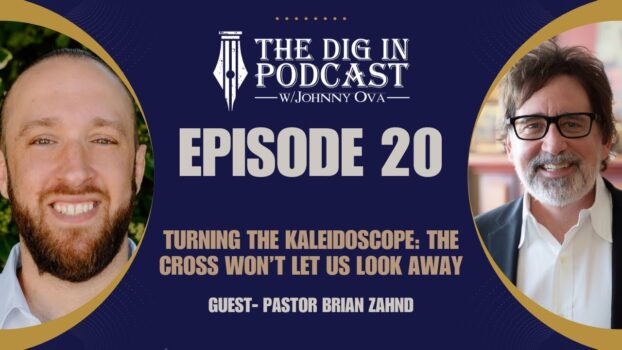
What if everything you’ve been taught about the cross is true, but incomplete? For most Western Christians, the crucifixion has been reduced to a single theological transaction: Jesus died to satisfy God’s wrath. But Pastor Brian Zahnd, author of The Wood Between the Worlds, challenges us to turn the kaleidoscope and discover that the cross refracts into countless meanings, each one revealing something profound about God’s character, human suffering, and the redemption of all things.
In this groundbreaking conversation on The Dig In Podcast, Pastor Zahnd takes us on a 500-mile pilgrimage through art, poetry, literature, and theological tradition to recover what the Western church has lost: a multifaceted understanding of the cross that honors mystery, embraces beauty, and refuses to reduce Christ’s death to a courtroom transaction.
The Cross Has Infinite Meanings: Understanding the Kaleidoscope
Pastor Zahnd opens the conversation with a striking image borrowed from C.S. Lewis’s The Magician’s Nephew. In Lewis’s story, there’s a place called “the wood between the worlds”, a mystical forest containing pools that connect to different realms. Zahnd applies this metaphor to the cross itself.
“The cross is the wood between the worlds,” Zahnd explains. “There is the world that was and the world that is and the world to come. But between those worlds is the cross that is ultimately healing all things.”
But why a kaleidoscope? Zahnd chose this image deliberately. When you look through a kaleidoscope, you’re always looking at the same source of light, but as you turn it, you see different geometric patterns and colors. The light itself hasn’t changed, only your perspective.
Breaking Free from Single-Meaning Theology
“I am a little bit frustrated with the idea that the cross has a singular meaning,” Zahnd admits. “Somebody gives you some dogmatic statement of a sentence or two and it’s like, all right, next question, please. And I don’t think you can do that with the cross.”
In The Wood Between the Worlds, Zahnd examines the cross through 19 different lenses, from Christus Victor to the sword-pierced soul of Mary, from the One Ring to Rule Them All (drawing on Tolkien) to God on the gallows. He’s careful to note that he’s not limiting the cross to 19 meanings. Rather, these are 19 windows into an infinite reality.
“In fact, in the book, I posit somewhat dramatically that in one sense, it’s quite possible that the meanings of the cross are infinite because God himself is infinite,” Zahnd says. “I don’t think we ever exhaust the meaning of the cross.”
This approach stands in stark contrast to the theological certainty that dominates much of evangelical Christianity today, where complex mysteries are flattened into simple formulas and divine paradoxes are resolved with systematic precision.
The Problem with Penal Substitutionary Atonement
For those unfamiliar with theological jargon, penal substitutionary atonement (PSA) is the dominant theory in Western Christianity about how the cross saves us. Simply put: humanity sinned, God’s wrath needed to be satisfied, and Jesus took the punishment we deserved.
Zahnd traces this theory back to Anselm in the 11th century, who was working within a medieval honor-shame culture. In feudal society, if a peasant offended a nobleman, the nobleman couldn’t regain his honor by punishing someone beneath his social status. He needed satisfaction from an equal.
“For Anselm, it’s about God recovering his honor,” Zahnd explains. “Who is his equal? Well, it’s his own son.”
From Honor to Wrath: The Reformation’s Intensification
Five hundred years later, the Protestant Reformers, particularly John Calvin, took Anselm’s framework and intensified it. Now it wasn’t just about honor but about divine wrath that had to be poured out on Jesus.
Zahnd identifies several problems with this theology:
- It does violence to the Trinity: The Father and Son are pitted against each other rather than working in perfect unity.
- It exonerates the principalities and powers: The actual human and spiritual forces that crucified Jesus (Roman imperialism, religious corruption, mob violence) disappear from the equation.
- It becomes invasive: Like an invasive species in ecology, PSA tends to take over and crowd out all other interpretations of the cross.
- It leads to “Jesus saving us from God”: This creates a bizarre theological situation where the wrathful Father needs to be appeased by the loving Son.
“Even if I thought penal substitutionary atonement theory was valid, which actually I don’t,” Zahnd says, “I would see it as problematic in that it seems to take over and become the sole meaning of the cross.”
The Eastern Orthodox Alternative
Significantly, Zahnd points out that Eastern Orthodox Christianity has never adopted PSA. For a thousand years before the Reformation and continuing to this day, the Eastern church has understood the cross primarily through the lens of Christus Victor (Christ’s victory over sin, death, and the devil) and the healing of human nature through Christ’s incarnation.
“It is uniquely Western,” Zahnd notes. “The Eastern Christians have never thought that way. In that regard, they’re better at their theology than we are in that department.”
The Pilgrimage That Changed Everything
The genesis of The Wood Between the Worlds came not from academic study but from spiritual pilgrimage. Nine years ago, Pastor Zahnd and his wife Peri began their first Camino de Santiago, the ancient 500-mile Christian pilgrimage path from France to Spain.
By providential timing, they began on September 14th, 2016, which in the church calendar is Holy Cross Day.
A 40-Day Walking Meditation
On that first day, after crossing the Pyrenees and arriving at the monastery in Roncesvalles, Spain, Zahnd went into the chapel to sit. There, he felt the Holy Spirit give him clear instructions:
“As you’re walking this Camino, enter every church you can, pay attention to the crucifix, ask what does this mean, and don’t be too quick to give an answer.”
For the next 40 days (a biblically significant number), Zahnd did exactly that. Two or three times a day, he would enter a church along the way and contemplate a different crucifix.
“These are all different,” Zahnd recalls. “Sometimes he looks regal. I remember one where he’s actually wearing not a crown of thorns but a kingly crown. Some you see the anguish of Christ. Some he’s serene and peaceful. Some you see that there’s definitely he’s the man of sorrow.”
Rather than rushing to theological conclusions, Zahnd simply sat with the mystery. With 500 miles of walking ahead, he had plenty of time to meditate without needing immediate answers.
Seven years later, he finally began writing The Wood Between the Worlds.
Why Poetry and Art Matter for Understanding the Cross
One of the most distinctive features of Zahnd’s approach is his use of poetry, art, literature, and film to explore the cross. The subtitle of his book is A Poetic Theology of the Cross, which doesn’t mean it’s written in verse but that it refuses to limit itself to academic prose.
The Limits of Prose
“We live in a time where prose language is entirely dominant,” Zahnd observes. “Post-Enlightenment, we think of the poetic as somehow lesser. And yet, if you will just pick up your Bible for crying out loud, you’ll realize that most of Isaiah is poetry.”
When we attempt to speak of the ineffable (that which cannot be adequately described in words), poetry opens doors that prose cannot. Song, sculpture, image, painting, literature, and film all become valid ways of receiving and communicating what the Holy Spirit reveals about the cross.
How a Roman Torture Device Became Beautiful
Johnny raised a profound point during the interview: “Only the blood of Christ could take a symbol that at the time was known as a Roman torture device and you cover it with the blood of Christ and now it’s the symbol of hope, joy, peace, love.”
Zahnd’s response cuts to the heart of why art matters:
“When the Romans were crucifying people, let’s just put it this way: they were not trying to create art. They were terrorizing. They were using psychological terror weapons upon an occupied populace.”
If we had a journalistic photograph of Good Friday at Golgotha, we might look at it once and never again. The raw brutality would be unbearable.
But artists throughout history have depicted the crucifixion “not in terms of brutality, horror, ugliness, but in terms of beauty.” This isn’t dishonesty. The role of the artist is to alert us to what we may have overlooked.
At the cross, there is the raw data of a Roman execution. But there’s infinitely more happening beneath the surface, and art helps us see it.
Drawing from the Whole Body of Christ
One of Zahnd’s core convictions is the importance of reading ecumenically, across the full spectrum of Christian tradition. He envisions the church as a seven-branched menorah:
- Eastern Orthodox
- Roman Catholic
- Anglican Communion
- Protestantism (in its thousands of iterations)
- Anabaptist (the radical Reformation)
- Evangelical
- Pentecostal/Charismatic
“I think they’re all beautiful,” Zahnd says. “They can all be ugly, too. They all have their ugly sides, but I’m not looking for ugliness. I’m looking for beauty.”
Learning from the Cappadocians
Throughout the book, Zahnd draws heavily on the Cappadocian Fathers: Basil the Great, Gregory of Nyssa, and Gregory of Nazianzus (also called Gregory the Theologian). These fourth-century theologians from what is now central Turkey are, in Zahnd’s estimation, “some of the very best theologians I think that we’ve ever produced.”
In a remarkable historical footnote, Zahnd notes that Basil and Gregory of Nyssa were brothers, and their primary teacher was actually their older sister, Macrina the Younger.
“Who I think are some of the very greatest theologians that we’ve ever had in the history of the church were actually taught by their sister,” Zahnd emphasizes.
This reminder challenges our assumptions about who gets to shape theology and whose voices have been systematically excluded from the conversation.
The Cross and Christian Nationalism
Given the political climate when this interview was recorded (“we’ve had a rough week here, this last seven, 10, 14 days,” Johnny noted), the conversation turned to how Christian nationalism distorts the cross.
Constantine’s Fatal Vision
The problem begins, Zahnd argues, in the early fourth century with the Emperor Constantine. According to legend, on the eve of the Battle of Milvian Bridge, Constantine saw a vision of the cross in the sky with the words “In this sign you shall conquer.”
“Of course, conquer means kill,” Zahnd notes bluntly. “Conquer is a euphemism for kill.”
The cross was applied as a talisman on Roman instruments of war. Constantine won the battle, and Christianity soon became the state religion of the Roman Empire.
Reverting the Cross to Violence
“I think that was a mistake, but it was probably an inevitable mistake,” Zahnd reflects. “But then what happens is the cross then becomes distorted. If you’re saying in this image you shall kill and the image is of a cross, the cross is reverting back to what it was under Rome. It’s a symbol of violence and intimidation instead of a symbol of co-suffering love.”
Christian nationalism is comfortable using the power of the state (the sword) to advance Christianity. But Zahnd insists this is fundamentally incompatible with the way of Jesus.
“What is the center of Christian faith? Of course it is the cross. Christ upon the cross, arms outstretched, in proffered embrace, not holding a sword.”
The Kingdom of God Is Without Coercion
The kingdom of God, Zahnd argues, is fundamentally without coercion. Christians persuade through “love, witness, spirit, reason, rhetoric, if need be martyrdom, but never by force.”
When Christianity aligns itself with state power and tries to advance by the sword, “what you end up with is a bastardized state religion that borrows Christian language and image, but the actual spirit of it is simply the world. It’s just the kingdoms of this world and it loses its actual ethos of being a kingdom of co-suffering love.”
Johnny pushed this even further, noting that beyond nationalism, Christians also defend people who look like them, talk like them, share their economic status and ethnic background. “And to do this in the name of Jesus,” he said, trailing off at the absurdity.
Zahnd’s response was direct: “Christian nationalism is sometimes a euphemism for Christian racism. It sounds a little more palatable.”
The Cross Forms Us, Not Just Saves Us
One of the crucial insights Zahnd brings is that the cross isn’t merely something Jesus does for us while we stand on the sidelines applauding. It’s also something that forms us as disciples.
Take Up Your Cross Daily
Jesus said explicitly, “If anyone would be my disciple, let him deny himself, take up his cross and follow me.”
“Imagine the first hearers of that,” Zahnd challenges. “When the cross has no religious or spiritual meaning, it is merely a means of Roman execution. And Jesus says, if you’re going to follow me, you’re going to have to be willing to die.”
This is the origin of Dietrich Bonhoeffer’s famous line: “When Christ calls a man, he bids him come and die.”
The cross represents voluntary self-denial for the sake of allegiance to Christ. It’s the way of co-suffering love that refuses to advance its cause through violence, coercion, or the power of the sword.
Franz Jägerstätter and A Hidden Life
To illustrate this cruciform discipleship, Zahnd points to Terrence Malick’s film A Hidden Life, which tells the story of Franz Jägerstätter, a 20th-century Austrian farmer who refused to take the Nazi loyalty oath and was executed as a result.
Zahnd knows the Catholic priest who consulted on the film and who knew Jägerstätter’s widow and daughters. According to this priest, “Terrence Malick got it just right.”
“If you haven’t seen it, it’s one of the greatest Christian films ever made,” Zahnd says. “As far as just in terms of just cinematography, it’s one of the most beautiful films you’ll ever see, but it’s telling the story of this 20th-century Austrian martyr.”
At Word of Mouth Church’s annual Lenten retreat, they showed the film. It’s a powerful depiction of what it looks like to take up your cross in the modern world.
The Cross as Public Lynching
One of the most wrenching perspectives Zahnd discovered was seeing the cross as a public lynching of an innocent man.
He was particularly influenced by James Cone’s book The Cross and the Lynching Tree, which draws connections between the crucifixion of Jesus and the lynching of Black Americans.
Confronting Local History
Zahnd lives in St. Joseph, Missouri, and he researched a lynching that took place in his own city in the 1930s. He went to the actual location where it happened.
“I just prayed and tried to confess the sins of my city,” he recalls. “Of course I wasn’t alive then and all that, but still, understanding that Christ died in solidarity with so many people throughout history who were subjected to unjust deaths.”
Whether people were accused of being witches, falsely charged with crimes, or lynched by mobs, Christ died in solidarity with them. And in the end, he will redeem them and restore their dignity.
“That was a new way of looking at the cross that did have a profound effect on me,” Zahnd says.
This perspective doesn’t replace other meanings of the cross. It adds another dimension, another turn of the kaleidoscope that reveals how Christ identifies with the victims of injustice throughout history.
Why Mystery Matters (And Why We’ve Lost It)
A recurring theme throughout Zahnd’s work is the importance of theological mystery. Yet mystery is precisely what modern Christianity has tried to eliminate.
From Mystery to Certitude
“We’re dealing with God,” Zahnd says simply. “And up until very late in modernity, we were comfortable with mystery because that’s how we knew we were broaching upon the truly divine.”
The logic is straightforward: if you can explain God completely, you’re either dealing with a very small god, or you haven’t actually encountered the divine at all.
The peak of contempt for mystery came in the late 19th and early 20th centuries, when technological advances created an illusion of total human mastery. Even entertainment reflected this. Consider Sherlock Holmes mysteries, which aren’t really mysteries at all but puzzles to be solved. Holmes always figures it out and declares, “It’s elementary, my dear Watson.”
The Return of Mystery in Culture
But something shifted toward the end of the 20th century. Popular culture began embracing genuine mystery again through shows like The X-Files and Lost, where not everything gets neatly explained.
“I think that’s good for theology and Christian faith,” Zahnd argues.
Too often, faith has been replaced by cheap certitude. We want answers to every question, and Christian apologetics programs promise to provide them. But this certainty is often fear-based rather than faith-based.
“Certitude is not only a cheap knockoff of faith, in some ways it’s the opposite of faith. It’s actually fear-based,” Zahnd observes.
Healthy Christianity Leaves Room for Mystery
“I think Christianity flourishes in a much more healthy way when we allow room for mystery and understand that I’m catching glimpses and I’m seeing things, I’m genuinely encountering the living God, but I can never explain all of God.”
This is especially true at the cross. We can articulate what we’ve seen, what Scripture reveals, what the Spirit illuminates. But we should never imagine we’ve exhausted its meaning.
The Bible Made Impossible: Pervasive Interpretive Pluralism
Johnny made an astute observation during the interview: “Everybody’s so certain that we have 20,000 denominations, right? Everybody says the Bible is so clear that nobody could agree on the same five things.”
Zahnd’s response cuts to a fundamental issue in modern Christianity:
“‘Bible-believing Christian’ is an empty signifier. It doesn’t mean anything. You just have to say it and you’re in the club. But the Bible is not a source of unity, right? Because it has to be interpreted.”
The Fistfight Thought Experiment
Zahnd offers a vivid illustration: “I can get 10 people that say, ‘I believe in the verbal plenary inspiration of scripture. I’m a Bible-believing Christian.’ Put them in a room and in 10 minutes I’ll have them in a fistfight.”
They all affirm the same things about Scripture’s authority, but they interpret it in radically different ways.
Christian Smith, in his book The Bible Made Impossible, identifies what he calls “pervasive interpretive pluralism”. This is the reality that there isn’t a single settled interpretation of Scripture. Faithful, intelligent Christians using the same hermeneutical principles arrive at vastly different conclusions.
Rather than seeing this as a crisis to be solved through more rigid systems, Zahnd suggests we need to “leave room for mystery” and recognize the limits of our interpretive certainty.
Practical Advice: How to Turn the Kaleidoscope
So how do ordinary Christians begin to see the cross from multiple angles? How do we escape the echo chamber and broaden our theological horizons?
Step Out of Your Tradition
“Get out of the echo chamber,” Zahnd urges. “Don’t be afraid to read beyond your own maybe narrow dogmatic tradition. I’m not saying that’s invalid. I’m saying just don’t be afraid to read something that’s Catholic or Orthodox or Anglican or Anabaptist.”
The key is to look for the best representatives of each tradition. You can always find the worst, but that proves nothing. Seek out the most thoughtful, faithful voices from across the body of Christ.
Read Widely and Historically
Zahnd recommends reading both across traditions (ecumenical width) and back through history (historical length).
Some starting points:
- The Cappadocian Fathers: Basil the Great, Gregory of Nyssa, Gregory of Nazianzus
- Robert Wilken’s The Spirit of Early Christian Thought (for those intimidated by reading church fathers directly)
- Eastern Orthodox theologians like Sergius Bulgakov
- The Wood Between the Worlds itself, which quotes extensively from diverse sources
“Read the Wood Between the Worlds and notice all the quotations,” Zahnd suggests. “Maybe you say, ‘Well, he keeps quoting this Sergius Bulgakov a lot.’ Well, then maybe go read one of his books.”
Hold Your Convictions Lightly Enough to Learn
“Don’t feel like you have to fight for a single interpretation or the one that you’ve inherited,” Zahnd advises. “You can hold on to that, but I mean there are other things to be said and there are other voices to be heard.”
This doesn’t mean abandoning your theological convictions. It means holding them with enough humility to listen, learn, and potentially discover new facets of truth you’d overlooked.
Warning Signs: When the Cross Has Been Reduced
How do you know if your understanding of the cross has been flattened into something less than it should be? Here are some red flags:
1. Single-answer theology: If you can explain the entire meaning of the cross in two sentences, you’ve likely missed something.
2. The cross becomes primarily legal rather than relational: When salvation is reduced to a courtroom transaction rather than a love story, something is wrong.
3. It doesn’t inform ethics: If your theology of the cross has nothing to say about violence, nationalism, racism, the death penalty, or how we treat enemies, it’s incomplete.
4. Mystery is eliminated: If there are no questions left, no sense of awe or wonder, you’ve traded faith for certitude.
5. Jesus is saving us from God: Any atonement theory that pits the Father against the Son or makes the Trinity work at cross-purposes needs reexamination.
6. It’s purely individualistic: The cross has cosmic implications. If it’s only about individual souls going to heaven, you’re seeing a fragment of the picture.
7. The principalities and powers disappear: The cross exposes and shames the powers of this world. If your theology doesn’t address this, ask why.
Looking Forward: What Comes Next
Pastor Zahnd has a new book releasing May 19th titled Unseen Existences: Of Heaven, Earth, and the Divine Mystery in All Things. He describes it as “sort of a book on Heaven” and “a book on the pilgrimage of the soul toward our true home in the heavenly.”
For Christians seeking to deepen their understanding of Scripture, the cross, and the nature of reality itself, Zahnd’s work offers a refreshing alternative to the reductionist theology that dominates much of Western Christianity.
His approach is neither liberal nor conservative in the conventional sense. He’s deeply committed to the authority of Scripture, the reality of the resurrection, and the centrality of Christ. But he refuses to be limited by the narrow interpretive frameworks inherited from one particular moment in church history.
Conclusion: The Cross That Heals All Things
The wood between the worlds is not a static object but a living reality that continues to refract divine light in infinite directions. Between the world that was and the world to come stands the cross, healing all things.
As Pastor Zahnd reminds us, we never graduate from the cross. We never exhaust its meaning. We never arrive at a place where we can confidently say, “Now we know all that the cross means.”
Instead, we return to it again and again, each time seeing something new. We turn the kaleidoscope and discover another pattern, another color, another dimension of God’s self-giving love.
The cross is Christ crucified, arms outstretched in embrace, inviting us not just to receive salvation but to join him in the way of co-suffering love. It’s a public lynching and a cosmic victory. It’s God on the gallows and the sword that pierces Mary’s soul. It’s the One Ring that rules them all and the center that holds when things fall apart.
It’s the wood between the worlds, and it will heal all things.
Watch This Profound Conversation
Don’t miss this rich theological discussion that challenges conventional thinking while deepening your understanding of the cross. Subscribe to The Dig In Podcast YouTube channel at https://www.youtube.com/@thejohnnyova for more scholarly conversations that make the Bible come alive.
Connect with Pastor Brian Zahnd
Explore more of Pastor Brian Zahnd’s work:
Books by Brian Zahnd:
- The Wood Between the Worlds: A Poetic Theology of the Cross – https://a.co/d/4nByL51
- Unseen Existences: Of Heaven, Earth, and the Divine Mystery in All Things (releasing May 19th)
- All books: https://www.amazon.com/stores/author/B00N6Q087U
Find Brian online:
- Search “Brian Zahnd” to find his Substack, Instagram, and sermon archives on YouTube
- Word of Mouth Church sermons available on YouTube
Stay Connected with The Dig In Podcast
Subscribe and Follow:
- YouTube: https://www.youtube.com/@thejohnnyova
- All Johnny’s links: https://linktr.ee/johnnyova
- Johnny’s book, The Revelation Reset: https://a.co/d/hiUkW8H