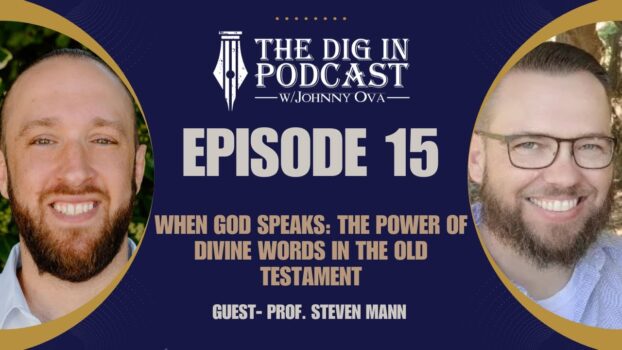
What if everything you thought you knew about God’s words in Scripture was only scratching the surface? When we read phrases like “God said” or “the word of the Lord came to me,” most Christians assume we understand what’s happening. But according to Professor Steve Mann, chair of the seminary at Azusa Pacific University and author of Words Creating Worlds: Old Testament Narratives and Speech Act Theory, there’s an entire dimension of divine communication that transforms how we read the Bible. In this groundbreaking conversation on The Dig In Podcast, Professor Mann introduces us to speech act theory, a philosophical framework that reveals not just what God’s words mean, but what they actually do in the world.
For pastors, church leaders, and engaged Christians seeking deeper biblical understanding, this conversation opens up narratives, prophetic books, and covenant moments in ways that make Scripture feel alive with divine activity. Mann’s expertise in Old Testament theology and his years as a youth pastor give him a unique ability to translate complex academic concepts into practical insights that strengthen faith and challenge conventional interpretations.
What Is Speech Act Theory and Why Should Christians Care?
Speech act theory originates from philosopher J.L. Austin’s 1955 Harvard lectures, later published as How to Do Things with Words. Austin’s revolutionary insight was simple but profound: language doesn’t just describe the world; sometimes speaking actually changes reality. When an umpire calls “strike,” the pitch becomes a strike regardless of where the ball crossed the plate. When a judge declares “guilty,” a person’s legal status transforms in that moment.
Professor Mann explains that Austin’s student, John Searle, identified five categories of speech acts that apply to all human language:
1. Assertives describe the world as it is (“Your brother’s blood is calling out to me from the ground” in Genesis 4)
2. Directives tell someone to do something (the Ten Commandments, prophetic calls to repentance)
3. Commissives commit the speaker to future action (God’s covenant promises to Abraham)
4. Expressives convey feelings without needing to match external reality (God’s anguished questions in Hosea 11)
5. Declaratives make something true simply by saying it (“Let there be light” in Genesis 1)
For biblical interpretation, this framework transforms how we understand divine communication. God doesn’t just issue commands and create worlds through declaratives. The Creator of the universe also describes reality through assertives, makes covenant promises through commissives, expresses divine emotion through expressives, and directs humanity through directives. “What speech act theory helps me to see,” Mann explains, “is that God speaks in not just the declarative… God is a person, not just a force like in Star Wars or an equation that you just have to figure out.”
The Power of Divine Speech in Genesis 1
When we encounter “and God said” in Genesis 1, we’re witnessing the most obvious biblical example of declarative speech acts. “Let there be light” doesn’t describe light or command light to appear. The utterance itself creates light. Mann notes that “by saying it, God enables that to happen.” This performative power demonstrates God’s ultimate cosmic authority over creation.
But Genesis 1 gains even deeper significance when we understand its ancient Near Eastern context. Mann walks us through the Babylonian creation myth called Enuma Elish, where the god Marduk must violently battle the chaos monster Tiamat to create the world. Marduk shoots an arrow through Tiamat’s open mouth, splits her body in two, and uses her remains to form the sky and seas. Humans are created from the blood of Tiamat’s defeated companion Kingu, fashioned specifically to serve as slaves doing the gods’ dirty work.
Against this backdrop of violent cosmic struggle, Genesis 1 presents a radically different picture. There’s no battle, no struggle, no conflict. When the Spirit of God hovers over “the deep” (Hebrew tehom, linguistically related to Tiamat), ancient audiences would have expected a fight. Instead, God simply speaks. Order comes through speech alone.
“Ancient audiences,” Mann explains, “their ears would perk up. They’re like, wait, is there going to be a fight here? I mean, this is the deep. This is Tiamat, right? And there’s no fight. And there’s no conflict. And so that just shows how much more powerful this God is to Marduk.”
This theological message would have been especially important for Israelites in Babylonian exile, feeling powerless under a massive empire. Genesis 1 declares that their God creates through effortless speech while Babylon’s greatest deity struggles against chaos.
Covenant as Divine Speech: When the Strong Serve the Weak
One of the most transformative insights Professor Mann shares comes from Walter Brueggemann’s understanding of covenant. Most Christians think of covenants as contracts with mutual obligations. While that’s not entirely wrong, Mann explains it misses the heart of biblical covenant.
“The clue to understanding covenant,” Brueggemann taught, “is that the strong agree to have their life shaped and largely determined by the character of the weak.”
This reframes everything. Covenant isn’t primarily contractual; it’s relational. The stronger party voluntarily limits themselves to operate on terms that accommodate the weaker party. We see this throughout Scripture:
When God makes covenant promises to Abraham (commissive speech acts), the Almighty commits to blessing all nations through this one man’s descendants. God doesn’t just command Abraham to obey; God binds God’s own self to Abraham’s success.
When God gives Torah directives to Israel, including laws about divorce that Jesus later explains were accommodations to “hardness of heart” (Mark 10), God is working within their cultural reality rather than imposing an unreachable ideal.
“God gives directives on things that are parts of the culture that God doesn’t actually endorse,” Mann explains, “but God is going to be involved with them, with the things in life that they will encounter.”
This has massive implications for how we read difficult passages. When the New Testament includes instructions about slaves obeying masters or wives submitting to husbands, these aren’t necessarily God’s ideal design for human relationships. They’re God meeting people in their Greco-Roman context, working within existing structures while potentially transforming them from within.
Mann points back to Genesis 1 to find God’s true intention: “God didn’t create any humans to submit to other humans. That’s what Christians would call result of the fall in Genesis 3.” Yet God continues working with fallen humanity, giving redemptive directives that move incrementally toward restoration.
For pastors and church leaders, this principle is liberating. It means we can distinguish between God’s ultimate vision (equality, mutual love, sacrificial service) and God’s willingness to meet people where they actually are. “What is God doing?” becomes a more helpful question than just “What does this mean?”
Prophetic Speech: When Human Words Carry Divine Authority
The prophetic books overflow with formulas like “thus says the Lord” and “the word of the Lord came to me.” But what’s actually happening when prophets speak? Are they just delivering messages, or is something more profound occurring?
Mann explains that prophets can employ all five types of speech acts, sometimes simultaneously. They might issue declaratives that make things happen (like Elisha calling down fire), deliver directives commanding repentance, make assertions about how God sees Israel’s sin, express divine emotion, or announce God’s covenant commitments.
The most fascinating dynamic involves what speech act theory calls illocutionary versus perlocutionary acts. An illocutionary act succeeds simply by being performed. When a waiter warns “the plate is hot,” the warning succeeds regardless of whether you listen. But the perlocutionary act (the intended result of not burning yourself) depends on your response.
This distinction illuminates countless prophetic encounters. When God directs Jonah to warn Nineveh, that directive succeeds as an illocutionary act. But whether Jonah obeys (perlocutionary goal) requires Jonah’s cooperation, which he initially refuses.
Even more striking is what happens when Jonah finally delivers God’s message. “Forty days and Nineveh will be overthrown” sounds like a declarative judgment. But the Ninevites treat it as a directive to repent, asking “who knows? God might give us a second chance.” When they repent, “God nahams,” which gets translated as having “a change of mind” about the destruction.
This leads Mann to one of Scripture’s most explicit statements about divine flexibility in Jeremiah 18. After the prophet observes a potter reworking spoiled clay, God declares:
“At one moment, I may declare concerning a nation or a kingdom that I will pluck up and break down and destroy it. But if that nation concerning which I have spoken turns from its evil, I will change my mind about the disaster that I intended to bring on it.”
God openly states that divine judgment speeches can function as directives inviting repentance rather than declaratives making destruction inevitable. The perlocutionary goal (turning people back to God) matters more than following through on threatened punishment.
“The way to respond to punishment is absolutely repentance,” Mann emphasizes. “God loves giving second chances. And Jonah knows that about God.”
The “Who Knows?” Theology of Hope
One phrase that particularly captivated Professor Mann’s research is the Hebrew expression ulay Adonai, translated “who knows? Perhaps the Lord…” This appears in unlikely moments of hope when characters face divine judgment but dare to ask for mercy.
The Ninevite king uses this phrase when calling for repentance. King David employs it when Shimei curses him during Absalom’s revolt, suggesting God might transform even cursing into blessing. It surfaces when someone faces disaster but refuses to presume God’s next move.
Mann admits this challenged his church kid certainty: “I never said, who knows? God might, X, Y, Z, right? Like, I know what God will do. Let me tell you.”
This “who knows?” theology represents healthy biblical humility about claiming to know exactly what God will do next. It creates space for surprise, for divine grace that exceeds expectations, for outcomes we didn’t see coming. For those facing judgment, discipline, or consequence, it means asking for mercy costs nothing and might reveal God’s preference for restoration over punishment.
A student once asked Mann whether someone in hell could ask God for salvation. While classmates snickered, Mann took the question seriously: “What do you got to lose? If God is someone who you know likes giving second chances, you lose nothing by asking God.”
This reflects the character of God revealed throughout Scripture: eager to forgive, slow to anger, preferring repentance to punishment, always leaving room for the “who knows?” of grace.
When Jesus Speaks: The Word Made Flesh
Though Mann jokingly claims to be “not very tech savvy” about the New Testament, his insights on how speech act theory illuminates Christology are profound. The opening of John’s Gospel combines Genesis 1’s creative Word with Proverbs 8’s personified Wisdom to identify Jesus as the Logos made flesh.
The writer connects Jesus with “God being the powerful word and also wisdom, like combining the wisdom there… to really show the identity of Jesus to be associated with the God of Scripture.”
Hebrews makes this connection explicit: “Long ago, God spoke to our ancestors in many and various ways by the prophets, but in these last days, he has spoken to us by a son… He sustains all by his powerful word.” Jesus represents both continuity and climax in God’s communicative acts.
When Jesus claims in Matthew 5:17 not to abolish the Law and Prophets but to “fulfill” them, Mann points out the Greek word pleroo means “fill up” or “fit with.” It’s used when Mary’s fragrance fills the house at Jesus’s anointing and when baskets overflow with miraculous bread and fish. “So pleroo is a filling out of something that came before it. Jesus says, don’t think that I’ve come to abolish the law of the prophets. I’ve come to fit perfectly with it.”
This has massive implications. Jesus doesn’t replace Old Testament directives but completes them, including the difficult ones. Mann finds “really good news for a lot of people” in the fact that God gives directives even about divorce in Deuteronomy 24, providing women certificates so they can restart their lives. “God is trying… to be redemptive and work with people, and I think that’s so beautiful and that Jesus fits with that.”
For Christians wrestling with how to relate to the Old Testament, speech act theory offers a framework. We don’t dismiss Torah as outdated or irrelevant. We recognize God working redemptively within ancient contexts, moving people incrementally toward the fuller revelation in Christ while never abandoning them in their brokenness.
Practical Applications for Pastors and Church Leaders
Preaching and Teaching
Understanding speech acts transforms sermon preparation. Instead of only asking “What does this passage mean?” pastors should ask “What is God doing in this text?” and “What are the characters doing with their speech?”
This opens up narratives that might otherwise feel flat. When David responds to Shimei’s cursing with “who knows if God might bring good?” you’re not just seeing David’s character but witnessing a theology of hope in action. When Jonah refuses to go to Nineveh, you’re watching someone reject God’s directive because they understand God’s covenant character too well.
Mann’s approach makes biblical characters more human and relatable. They’re not just examples to follow or avoid, but people engaging in speech acts with God and each other, sometimes succeeding in their goals and sometimes failing.
Pastoral Care
The distinction between God’s ideal intentions (Genesis 1) and God’s redemptive accommodations (covenant directives in difficult circumstances) gives pastors language for helping people in complex situations.
When someone faces divorce, abuse, or structural injustice, they need to know God isn’t just commanding an impossible ideal but walking with them through messy reality. God gave directives about divorce not because divorce is good but because God refuses to abandon people in brokenness.
This framework helps pastors avoid two extremes: legalistic rigidity (“the Bible says this, so you must do exactly this”) and relativistic dismissal (“that was just cultural, so it doesn’t matter”). Instead, we can ask: What is God doing in this directive? How does it move toward redemption? How does Christ fulfill and complete this?
Discernment and Application
Not every biblical directive represents God’s ultimate will. Some accommodate fallen human systems (slavery, patriarchy, violence) while working incrementally toward transformation. But we need Christ and the trajectory of Scripture to discern which is which.
Mann cautions: “We need to have some discernment. What is God doing is a wonderful question to ask as opposed to just, what does this mean? Does this mean I have to do this?”
Warning signs of misapplying biblical directives include:
- Using accommodation texts to justify oppression rather than liberation
- Ignoring the trajectory from Old Testament accommodation toward New Testament fulfillment in Christ
- Treating cultural directives as timeless while dismissing timeless principles as cultural
- Missing how Jesus and early Christians challenged unjust systems even while working within them
Community Formation
Understanding covenant as the strong accommodating the weak should shape how church communities function. Following Christ means living on behalf of weaker members, considering how our freedom affects others (Romans 14-15), and embodying Philippians 2’s self-emptying love.
“That’s covenantal living,” Mann explains, describing how Jesus “doesn’t consider equality with God something to be attained but humbles himself on the cross.”
Churches that grasp this won’t insist on rights and freedoms at others’ expense but will gladly limit themselves for the vulnerable. This applies to worship style preferences, theological debates, leadership structures, and countless other areas where the powerful typically dominate.
Modern Applications and Current Relevance
Social Media and Digital Communication
Speech act theory has urgent relevance for online discourse. When Christians post, tweet, or comment, what are we doing with our words? Are we issuing directives without authority? Making declarations we can’t fulfill? Expressing emotions without considering perlocutionary effects on readers?
Understanding the difference between illocutionary and perlocutionary acts might make us more careful. Your post achieves its illocutionary goal (expressing your opinion), but does it achieve your perlocutionary goal (changing minds, building understanding, glorifying God)?
Mann’s student who asked about praying for salvation from hell was essentially asking whether perlocutionary effects (God’s response) might surprise us. The answer applies to much of our communication: we can’t control others’ responses, but we can be faithful in our illocutionary acts.
Political and Cultural Engagement
The distinction between God’s ideal design and redemptive accommodation within fallen systems offers wisdom for navigating political questions. Christians can simultaneously affirm God’s vision for human flourishing while recognizing that policies and laws often represent incremental movement within broken systems.
This prevents both utopian idealism (“we must implement the kingdom of God through legislation”) and cynical resignation (“nothing matters because the world is fallen”). Instead, we can work for improvements that move toward God’s intentions even when we can’t achieve them fully.
Worship and Prayer
Recognizing that God uses expressive speech acts (conveying emotion) transforms how we approach worship and lament. When God asks in Hosea 11 “How can I give you up, O Ephraim?” that’s divine anguish, not just information.
Our prayers can likewise employ all five types of speech acts. We make assertions about the world’s brokenness, direct God’s attention to needs (boldly!), commit ourselves to obedience, express honest emotions, and even dare to use declaratives in Jesus’s name. Understanding what we’re doing with our words deepens both corporate worship and personal devotion.
Future Implications and What to Watch For
Professor Mann revealed he’s working on a new book specifically exploring God’s speech acts throughout Scripture, going “chapter by chapter” to examine divine directives, commissives, and other categories systematically. This promises to be an invaluable resource for pastors and scholars wanting to apply these insights comprehensively.
The broader field of speech act theory in biblical studies continues developing. As more scholars apply these philosophical frameworks to Scripture, we can expect fresh insights on:
- How different biblical genres employ speech acts (narrative vs. prophecy vs. wisdom literature)
- The relationship between divine speech and divine action
- How speech act categories illuminate theological debates about God’s sovereignty and human free will
- Applications to contemporary issues in ethics and social justice
For church leaders, staying engaged with these developments offers tools for faithful biblical interpretation that takes both ancient context and contemporary application seriously.
Returning to Scripture with Fresh Eyes
When asked what passage listeners should revisit with speech act theory in mind, Professor Mann immediately suggested the book of Jonah. This familiar story transcends even religious boundaries, making it perfect for fresh examination.
“We are Jonah,” Mann explains. “We know so much about God, but where’s our heart? Are we listening to God?”
Jonah’s anger at God’s grace toward Nineveh reveals a common Christian problem: we love that God is gracious to us but resist extending that grace to others, especially enemies. A visiting pastor once asked Mann’s congregation why Christians seem so angry, connecting it to Jonah’s rage over mercy.
“Jonah’s very happy that God is full of grace for him and those like him, right? He doesn’t want God’s grace to be given to his enemies.”
For pastors and church leaders facing division, political polarization, and cultural hostility, Jonah offers a mirror. Do we truly want God to be gracious to those we disagree with? Or would we rather see judgment fall?
Practical Steps for Implementation
For Individual Bible Study
- Ask “What is being done?” not just “What does this mean?”
- Identify the speech act type in divine communications and character dialogue
- Notice perlocutionary success and failure when characters respond to God’s speech
- Look for the “who knows?” moments where hope persists despite judgment
- Connect Old Testament patterns to Christ as the ultimate fulfillment
For Preaching Preparation
- Analyze speeches in narrative passages using the five categories
- Explore why God chose this type of speech act in this situation
- Consider what the original audience would understand about divine communication
- Apply the text’s speech act dynamics to contemporary situations
- Avoid flattening God’s communication to mere information transfer
For Teaching and Discipleship
- Help people see God as personal, not just a force or rulebook
- Distinguish between God’s ideals and redemptive accommodations in difficult texts
- Emphasize God’s willingness to meet us where we are
- Encourage honest expression of emotion to God (expressives)
- Model covenant living where the strong serve the weak
Don’t Miss This Eye-Opening Conversation
Professor Steve Mann brings decades of Old Testament scholarship and pastoral experience to bear on how we read God’s Word. His ability to make complex philosophical frameworks accessible while maintaining scholarly rigor makes this conversation invaluable for anyone seeking deeper biblical understanding. Subscribe to The Dig In Podcast YouTube channel at https://www.youtube.com/@thejohnnyova to catch every episode that challenges conventional interpretations and opens Scripture in fresh ways.
Connect With Professor Steve Mann
Books and Publications:
- Words Creating Worlds: Old Testament Narratives and Speech Act Theory (Lexington Books, 2025)
- Run, David, Run! (Eisenbrauns, 2013)
- “Let There Be Cain: A Clash of Imaginations in Genesis 4” in Journal for the Study of the Old Testament 46.1 (2021): 79-95
- “Ask and You Shall Intercede” in Bulletin for Biblical Research 29.2 (2019): 208-224
- “Performative Prayers of a Prophet” in Catholic Biblical Quarterly 79 (2017): 20-40
- “You’re Fired: An Application of Speech Act Theory to 2 Samuel 15.23-16.14” in JSOT 33.3 (2009): 315-334
Professor Mann serves as chair of the seminary at Azusa Pacific University and remains actively involved at Rose Drive Friends Church in Yorba Linda, California. While he admits to being a “lurker” on social media who prefers doom scrolling to posting, his academic work speaks powerfully through his publications and teaching.
Stay Connected With The Dig In Podcast
For more conversations that bring scholarly insight and historical context to biblical topics, making complex ideas accessible for pastors, church leaders, and engaged Christians:
Subscribe on YouTube: https://www.youtube.com/@thejohnnyova
Follow Johnny Ova: https://linktr.ee/johnnyova
Read Johnny’s Book: The Revelation Reset available at https://a.co/d/hiUkW8H