When most Christians reach for the Book of Psalms, they’re looking for comfort, devotional inspiration, or the perfect verse to match their current emotional state. But what if we’ve been missing the forest for the trees? What if these ancient Hebrew poems were never meant to be personalized devotional soundbites, but rather a comprehensive theological framework that shaped Israel’s corporate worship and national identity?
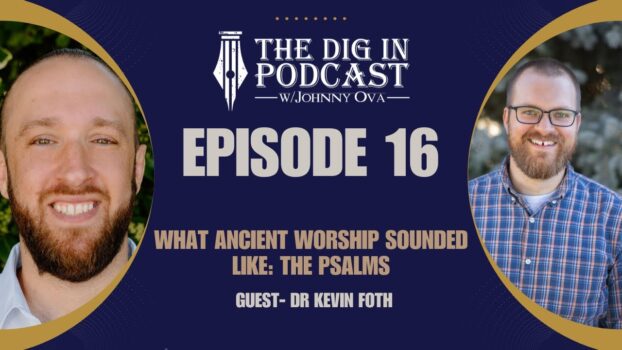
Dr. Kevin Foth, scholar of Old Testament wisdom literature and worship leader, joins The Dig In Podcast to pull back the curtain on how ancient Israel actually used the Psalms. With a forthcoming book on wisdom from IVP Academics and his recently published work “Semantics and Poetics of the Righteous and the Wicked in the Psalms,” Dr. Foth brings both scholarly rigor and pastoral sensitivity to a conversation that challenges our modern worship assumptions. This isn’t just an academic exercise. Understanding the original context of the Psalms transforms how we pray, how we worship, and how we understand God’s character in seasons of both celebration and suffering.
What Ancient Temple Worship Actually Sounded Like
The Sensory Experience of Psalm-Singing
Forget the quiet, contemplative image you might have of ancient worship. Dr. Foth paints a radically different picture: “If you imagine the temple or the sanctuary in the ancient world, the first thing that comes to mind would be loud. You have a lot of people who are coming and going, it’s bustling in the area around the temple.”
The temple worship experience involved:
- Polyphonic chanting that resembled the Islamic call to prayer more than modern worship songs
- Multiple voices dialoguing with each other throughout the psalm
- Trumpet, harp, lyre, timbrel, and other instruments mentioned in Psalm 150
- Dancing and singing as part of communal celebration
- Festival atmospheres with feasting, drinking, and corporate joy
This wasn’t private devotional reading. The Psalms were performed, likely during major festivals when the community gathered to remember God’s faithfulness to Israel. Dr. Foth explains that while we don’t have definitive evidence for exactly where in the temple complex these performances occurred, the temple entrance liturgies (Psalm 15, Psalm 24) suggest movement and progression toward sacred space.
The Role of Temple Geography
The temple’s three-part structure (outer courts, secondary courts, and Holy of Holies) created natural progression in worship. While the Holy of Holies remained restricted to specific personnel at specific times, the Psalms of Ascent (Psalm 120-134) may reference literally ascending the temple steps while singing.
“There are all sorts of indications that there might have been singing, there may have been participation with the song aspect of worship,” Dr. Foth notes, “but that’s as much as our evidence really says.”
Beyond Personal Devotionals: The Psalms as Israel’s Story
The Composition vs. Performance Question
One of the most striking insights Dr. Foth offers challenges our journaling-style approach to the Psalms: “In terms of locking yourself in a corner and pouring your heart out before God like we do with journaling today, I don’t necessarily think that’s the exact same thing.”
The scribal culture of ancient Israel meant that writing was limited to royal retinues and priestly classes. Poetry composition likely took years, with multiple contributors potentially expanding and refining pieces over time. Dr. Foth references Gerard Manley Hopkins, whose famous poem “The Wind Hover” took years to complete after the initial inspiration.
The 150 Psalms we have represent the written, textualized versions that survived, not necessarily all the psalms ever performed in temple worship. Scholars debate whether certain psalms (like Psalm 1) were ever actually performed in corporate worship at all.
Key Theological Themes That Shape the Psalter
Land theology appears repeatedly throughout the Psalms. For ancient Israel, the land wasn’t just geography but represented God’s covenant faithfulness. Loss of land through exile raised existential questions about Israel’s identity and God’s presence.
Temple theology permeates the psalter. Psalm 74 represents this crisis powerfully: “Who are we if we don’t have our association with Yahweh? Who are we if we no longer have the place where we went to worship God?” Dr. Foth asks.
Royal kingship appears in numerous psalms that reference David, Solomon, and the monarchy. Understanding this helps modern readers see that many psalms addressed national concerns, not just individual spiritual experiences.
Justice for the oppressed emerges as perhaps the most uncomfortable theme for wealthy Western readers. Dr. Foth challenges us: “Sometimes if we turn that flashlight around, it’s almost like David with Nathan: you are the one. Sometimes we have to read this like, well, how are we actually participating in the poor being oppressed?”
The Missing Element: Why Modern Worship Needs Lament
The Problem-Solution-Praise Formula
As both a scholar and worship leader, Dr. Foth conducted revealing research: “I did a cataloging one time of our top 100 songs on CCLI, the ones that we’re actually singing in church. And almost all of them had the same kind of general sense that there was a problem, God solved it, I’m happy.”
This problem-solution-praise formula dominates contemporary Christian worship. It’s not wrong, but it’s incomplete. The lament psalms offer something our sanitized worship sets don’t: permission to stay in the distress without rushing to resolution.
The Theology of Unresolved Pain
Only one psalm (Psalm 88) ends without praise or affirmation of God’s identity. It concludes with the haunting line: “Darkness is my only friend.” Dr. Foth points out that this canonical inclusion matters: “It’s so helpful to know that Psalm 88 exists.”
Real people experienced real suffering, and the biblical writers didn’t force premature closure on their pain. Dr. Foth shares a poignant pastoral moment: “I have a friend who after losing a child went to one of the Psalms. And I was in my academic room like, ‘this isn’t what that Psalm is about.’ I didn’t say that, don’t worry.”
Poetry’s power lies in its reapplicability. While the historical context matters for proper interpretation, the emotional landscape of the Psalms transcends specific ancient situations.
Lament as Corporate Practice
Lament worship remains common in non-Western contexts where suffering is more apparent. For wealthy Western Christians, Dr. Foth suggests lament offers something different: “One of the ways that lament helps us is to actually see things from the perspective of someone who has a different experience from ours, to be able to call out to God on behalf of those who are suffering.”
Without lament, praise becomes cheap. Dr. Foth explains: “To have praise without lament, I think cheapens our understanding of why we’re praising in the first place. If we are just saying ‘thank you God, God is good, God is good all the time,’ I think that we’re missing the point that yeah, but life isn’t.”
The Full Emotional Spectrum: Why Rawness Matters
Permission to Feel Everything
Modern church culture often promotes emotional suppression disguised as faith. Dr. Foth challenges this directly: “It’s almost like the church expects suppression in some areas where it is not okay to rage out when you’re feeling rage out. And I feel like that is damaging.”
The Psalms include:
- Rage (Psalm 137’s desire for enemies’ children to be dashed against rocks)
- Despair (Psalm 42’s “Why have you forgotten me?”)
- Doubt (Psalm 73’s questioning of God’s justice)
- Confusion (Psalm 44’s “Wake up, Lord!”)
- Joy (Psalm 100’s call to joyful noise)
- Gratitude (Psalm 103’s catalog of God’s benefits)
This emotional range isn’t a bug but a feature. Dr. Foth explains: “Humans are emotional beings. And so the Psalms give us language to express our frustration, our anger toward God.”
The Physiological Need for Emotional Expression
From a purely physiological perspective, emotional suppression causes harm. “Sometimes you can’t move past something you’re feeling unless you cry,” Dr. Foth notes. “If the Psalms give you the power to cry, then I think they’re doing something good for us and for our experience of God because it opens us up to what he has to say to us.”
The lament structure typically moves from distress to petition to trust, but the movement isn’t instantaneous. The Psalms model a process: “Maybe we don’t end in a 10 verse poem with happy feelings like some of the psalmists seem to, but that is a process. You have to go through that valley.”
God’s Silence and the Crisis of Expectations vs. Reality
What “Silence” Actually Means
When the psalmists complained about God’s silence, they weren’t primarily lamenting the absence of audible divine speech. Dr. Foth clarifies: “Silence is the failure of God to act. They weren’t expecting God to speak necessarily, but to act in a situation.”
This distinction matters enormously. Modern Christians often conflate emotional feelings of God’s presence with actual divine presence. Dr. Foth pushes back: “We tend to be a little bit overly emotional in our practices that when I feel good I feel God’s presence. And I know he’s there. But you can feel good and maybe not be walking in what God has for you.”
The Scholar’s Personal Struggle
Dr. Foth’s transparency here is powerful: “One of the ways I personally have benefited most from the Psalms and studying the Psalms is thinking through living in the world where I believe that God exists, I believe that He is with me. But sometimes, I just don’t see the evidence of that.”
He continues with pastoral wisdom: “I call to God and I can say in hindsight, wow, I can see where he was, but in the moment, he is literally invisible. We just have to deal with this as Christians and maybe have some compassion on people who don’t believe in God just because we can’t see him.”
This is the expectations vs. reality crisis that dominates the Psalms. Ancient Israel expected God to protect them from enemies, preserve the temple, maintain the Davidic monarchy. When reality didn’t align with covenant expectations, honest wrestling ensued.
The Justice Theme We’d Rather Skip
Psalm 72 and the King’s True Purpose
Psalm 72 represents what scholars believe was a coronation prayer, possibly for Solomon. Modern readers love the “may he rule from sea to sea” parts. But Dr. Foth emphasizes the purpose: “Why? Because he will deliver the needy who cry out. It’s actually those people who are the ones who are most in need.”
The king’s legitimacy depended on justice for the oppressed, not military might or economic prosperity.
The Job Connection
Dr. Foth makes a brilliant connection to the Book of Job that exposes modern Christian blind spots. When Job defends his righteousness, contemporary readers expect him to cite sexual purity (which he does mention briefly). But the bulk of Job’s defense focuses on economic justice:
“When there was someone who was hungry, I fed him. When there was a woman who was, or someone, a widow, I clothed her. All of these things, so for him, his justification of ‘I haven’t been a sinner,’ it’s actually he did the work of justice in his life.”
Dr. Foth challenges us: “It is this idea that for the ancient writers of Job, the most important things were not the sins of what have I done, but more what have I not done.”
The Uncomfortable Mirror
The Psalms concerning injustice should make wealthy Western Christians uncomfortable. Dr. Foth doesn’t shy away: “It’s easy to say, yeah, injustice, bad, let’s go towards justice, but it’s harder to read it with these eyes that, man, what are the systems of injustice today? What are the places that we see injustice and how can we actually do something about that?”
Recovering Ancient Practice for Modern Worship
The Content vs. Style Distinction
Modern worship debates center on musical style preferences: traditional hymns vs. contemporary songs, organs vs. guitars, formal vs. casual. Dr. Foth cuts through these debates: “I don’t think it talks about personal taste so much.”
The Psalms care about content over style. What story are we telling? How does corporate worship shape our understanding of God’s character and our role in His world?
The Surprising Horizontal Focus
Dr. Foth’s PhD supervisor, Mark Boda, counted how often psalms address God vertically versus address people horizontally. The results surprised everyone: “It’s about the same amount. Like it’s slightly more up than horizontal, but if you think about ‘is this phrase directed at other people,’ it’s almost 50% of the time.”
This reveals that worship is communal, not just individual. The Psalms weren’t written for private devotional time alone but to shape collective identity and mutual encouragement.
Practical Steps for Recovery
Dr. Foth’s advice for modern Christians is refreshingly simple:
- Read the entire Psalter in one week to get the full scope
- Then read one psalm daily for deeper reflection
- Then read the entire Psalter again in one week to see it with new eyes
- Read the Psalms in context of the whole biblical story
- Don’t assume you’re the hero of every psalm
- Look for Israel’s national story, not just personal application
- Read them aloud because they were meant to be performed
- Memorize them to internalize their theological framework
- Turn them into prayers that shape your conversations with God
- Use your imagination to enter the world the Psalms create
“Don’t assume that you are in this story in the way that you have,” Dr. Foth warns. “Don’t assume that these are about personal problems necessarily. Look for the story of Israel in them because that’s so much part of it.”
The Psalms and Creation Care
One overlooked theme Dr. Foth mentions deserves expansion: creation theology in the Psalms. “The birds praise God, the trees, all of these things, like the Psalms actually invite us to be outside and just be like to touch grass.”
In an increasingly digital, disconnected age, the Psalms ground us in physical creation as a witness to God’s character. This isn’t New Age nature worship but recognition that God’s handiwork declares His glory (Psalm 19).
Warnings for Modern Readers
Don’t Weaponize the Psalms
The imprecatory psalms (those calling down curses on enemies) require careful handling. These weren’t licenses for personal vengeance but expressions of trust that God would execute justice when human systems failed.
Don’t Skip the Uncomfortable Parts
Dr. Foth’s challenge about justice bears repeating: wealthy Christians often read Psalms as if they’re the oppressed crying out, when they may actually be the oppressors the psalmists condemned.
Don’t Flatten the Emotional Landscape
The pressure to end every difficult season with “but God is good” can prevent genuine processing. Dr. Foth’s observation matters: “There’s a sense in which that’s good. You want to tell yourself the truth. God is good. There’s truth behind that. But there’s a sense in which you’re kind of just cheapening your experience.”
Don’t Ignore the Communal Nature
Reading Psalms as purely individual devotional material misses their corporate worship function. These texts shaped how Israel understood their collective identity, not just how individuals felt about God.
For Pastors and Worship Leaders
Recovering Lament in Congregational Worship
Dr. Foth’s dual role as scholar and worship pastor gives him unique insight. Introducing lament songs requires pastoral wisdom:
- Start with testimonies from church members about seasons of suffering
- Choose lament songs that move toward hope without forcing premature resolution
- Create space for corporate confession and grief
- Don’t apologize for songs that make people uncomfortable
- Frame lament as biblical faithfulness, not negativity
Teaching the Psalms Contextually
Help congregations understand:
- The historical background of specific psalms
- How Israel’s story shapes the theological themes
- The difference between personal application and original meaning
- Why understanding context enriches rather than limits relevance
Balancing Individual and Corporate
Modern evangelical worship leans heavily individualistic (“I,” “me,” “my”). The Psalms balance this with corporate identity (“we,” “us,” “our”). Intentionally choose songs that reflect both.
The Scholarly Foundation That Changes Everything
Dr. Foth references Sigmund Mowinckel and his teacher Hermann Gunkel, pioneers of form criticism who identified the genres and structures within the Psalms. Their work (cult functionalism) emphasized the liturgical setting of the Psalms.
Understanding these psalm genres helps readers know what to expect:
- Individual laments (Psalm 3, 5-7, 13, 22, etc.)
- Community laments (Psalm 44, 74, 79, 80)
- Individual thanksgiving (Psalm 30, 32, 34, 116)
- Community thanksgiving (Psalm 65, 67, 124)
- Hymns of praise (Psalm 8, 19, 29, 33, 100, 103-104)
- Royal psalms (Psalm 2, 18, 20-21, 45, 72, 110)
- Wisdom psalms (Psalm 1, 37, 49, 73, 112, 127-128)
- Torah psalms (Psalm 19, 119)
Each genre had its own liturgical function in ancient worship, though the details remain debated.
Future Implications: Where This Leads
Understanding the Psalms in their original context doesn’t limit their application but enriches it. Christians can:
- Develop more robust theology of suffering that doesn’t rush to resolution
- Recover corporate worship that shapes community identity
- Engage social justice issues as acts of worship
- Practice emotional honesty before God without guilt
- Connect with the historic faith of God’s people across millennia
- Develop biblical imagination that sees God’s world more clearly
Dr. Foth’s forthcoming book on wisdom literature promises to expand these insights into Proverbs, Job, and Ecclesiastes. His approach to the Psalms demonstrates how rigorous scholarship serves pastoral ministry rather than competing with it.
What to Watch For in Your Own Psalm Reading
As you engage the Psalms with fresh eyes, notice:
- How often justice for the poor appears (you’ve probably missed this)
- The corporate “we” language versus individual “I”
- References to Israel’s history (Exodus, wilderness, conquest, exile)
- The temple and Zion as central theological categories
- How lament moves toward trust without denying pain
- The creation themes throughout the psalter
- The range of emotions God’s people brought before Him
- How expectations clash with reality in honest prayer
The Bottom Line for Engaged Christians
The Book of Psalms wasn’t written to be cherry-picked for inspirational Instagram quotes or pulled out in crisis moments. These 150 poems formed the theological backbone of ancient Israel’s worship, shaping how they understood God’s character, their national identity, and their role in God’s redemptive purposes.
Dr. Foth’s scholarship demonstrates that understanding the historical context doesn’t diminish the Psalms’ relevance but intensifies it. When we see Israel wrestling with the same faith questions we face (Where is God when life falls apart? Why doesn’t He act when we need Him? How do we maintain hope in exile?), their prayers become our prayers in deeper ways.
For pastors, this means recovering lament in corporate worship, teaching the justice themes that make comfortable Christians uncomfortable, and helping congregations see themselves in the ongoing story of God’s people rather than just isolated individuals seeking personal blessing.
For everyday Christians, this means reading the Psalms repeatedly and comprehensively, not selectively for comfort. It means allowing these ancient prayers to shape our emotional vocabulary before God and our understanding of what worship actually entails.
Don’t Miss This Conversation
Watch the full interview with Dr. Kevin Foth on The Dig In Podcast to dive deeper into the ancient worship practices, the theological themes that matter most, and practical wisdom for reading the Psalms in ways that transform your faith. Dr. Foth’s combination of scholarly expertise and worship leadership experience offers insights you won’t find elsewhere.
Subscribe to The Dig In Podcast YouTube channel at https://www.youtube.com/@thejohnnyova for more conversations that bring biblical scholarship into accessible dialogue for pastors and engaged Christians.
Connect with Dr. Kevin Foth
Dr. Foth’s recently published work, “Semantics and Poetics of the Righteous and the Wicked in the Psalms”, explores the justice themes discussed in this conversation in greater depth. Find it on Amazon: https://a.co/d/iFXdlY4
His forthcoming book on wisdom literature with IVP Academics (releasing in approximately one year) will expand these insights into Proverbs, Job, and Ecclesiastes from the same scholarly and pastoral perspective.
Stay Connected with The Dig In Podcast
For all things Johnny Ova and The Dig In Podcast, visit: https://linktr.ee/johnnyova
Read Johnny’s book “The Revelation Reset” for his preterist perspective on eschatology and the fulfillment of prophecy: https://a.co/d/hiUkW8H
Join thousands of pastors, church leaders, and engaged Christians who are going deeper into Scripture’s historical context and discovering the richness that comes from understanding the Bible on its own terms.