
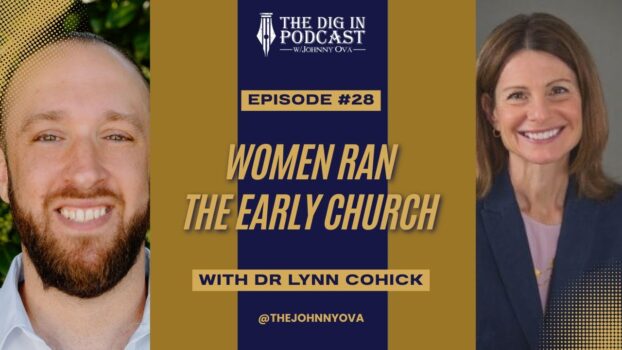
What if everything you thought you knew about women in the early church was wrong? What if the “silent” women of the New Testament were actually powerful leaders, wealthy patrons, and recognized apostles whose stories have been buried for nearly 2,000 years?
Dr. Lynn Cohick, Distinguished Professor of New Testament at Houston Christian University and President of the Institute for Biblical Research, has spent decades uncovering the shocking truth about women in early Christianity. Her groundbreaking research using ancient inscriptions, business documents, and archaeological evidence reveals a stunning picture that transforms how we should read the New Testament.
Mary Magdalene: Businesswoman, Not Prostitute
One of the most explosive revelations involves Mary Magdalene. Dr. Cohick’s research proves she was likely a successful businesswoman or trader, not the prostitute that centuries of church tradition claimed. This misidentification happened as late as 591 AD when a Pope combined multiple biblical women into one composite character.
“Mary Magdalene is mentioned in Luke 8 as a benefactor of Jesus,” Dr. Cohick explains. “She had enough resources that she’s able to contribute and be known for contributing to Jesus’ ministry.” The evidence points to a wealthy woman who used her financial independence to support the early Christian movement.
But how did this massive historical error happen, and what does her real story tell us about women’s roles in the early church? The full answer will shock you.
The Hidden Power of Female Patrons
The early church wasn’t funded by institutional donors or denominational budgets. It was funded by women patrons and benefactors who used their wealth and social connections to support apostles like Paul. Dr. Cohick’s research reveals how women like Phoebe operated as Paul’s “prostatis” (patron), providing not just money but introductions, protection, and hospitality.
“Phoebe is the deacon of Kenchreae, which is the eastern port of Corinth,” Dr. Cohick notes. “She is a benefactor of Paul. Sometimes English translations use the word ‘helper.’ That’s a really weak translation of what is a descriptor of a relationship at this time.”
Lydia of Philippi represents another powerful example. When she converted to Christianity, “she and her household were baptized. So she is running the house. She is the person that was the decision maker in the house.” Her home became the first church in Europe, and she provided safety and resources for Paul’s dangerous ministry.
Archaeological Evidence Changes Everything
Recent archaeological discoveries have shattered traditional assumptions about women in biblical times. Ancient inscriptions show women serving as “Archisynagogos” (leaders of the synagogue), a title that archaeologists initially assumed must be honorary because they couldn’t believe women held functional leadership roles.
“When they were first discovered, the archaeologist assumed that it was an honorary title, that it couldn’t actually be functional,” Dr. Cohick explains. “Then more women scholars began looking at this and saying, why are we assuming that this is honorary and not functional?”
The evidence extends beyond Jewish communities. In Pompeii, Eumachia’s statue honors her as patron of the Fullers Guild, one of the most important trade organizations. Throughout the Roman Empire, inscriptions and tombstones reveal women exercising authority and influence in ways that contradict the “silent and submissive” stereotype.
Paul’s “Problematic” Passages Finally Make Sense
Dr. Cohick’s research provides crucial context for understanding Paul’s controversial statements about women in ministry. When Paul writes “women should be silent,” he’s addressing specific situations of chaos and disruption, not establishing universal prohibitions for all women everywhere.
“Paul has no problem that Phoebe is a deacon,” Dr. Cohick points out. “He talks about Euodia and Syntyche as his coworkers whose names are written in the book of life. He speaks only with praise for Priscilla and Aquila. And we know from Acts chapter 18 that Priscilla and Aquila taught Apollos the finer or deeper things about scripture.”
The key insight? Paul’s practice reveals his actual beliefs about women’s capabilities and calling. When we understand the specific cultural contexts he was addressing, his seeming contradictions disappear.
The Female Apostle They Tried to Erase
Perhaps the most shocking revelation involves Junia, whom Paul identifies as “outstanding among the apostles” in Romans 16:7. For the first several centuries of church history, everyone knew Junia was a woman’s name. But in the 13th century, a monk deliberately changed the name to the masculine “Junias” in his Latin translation.
“We have like 250 inscriptions in Rome alone with that female name,” Dr. Cohick reveals. “Junius with an S on the end is actually a made-up name.” The church has been reading a falsified text for nearly 800 years.
Why This Matters for Churches Today
This isn’t just ancient history. Dr. Cohick’s research has profound implications for how modern churches understand biblical leadership and women’s roles. When we recognize that women served as patrons, deacons, apostles, and house church leaders in the New Testament era, it transforms our understanding of God’s design for His people.
“When women and men recognize that this is a job we do together to help faithfully represent together Christ to the world, it strengthens us and encourages us,” Dr. Cohick explains.
The early church thrived because it leveraged the gifts, resources, and leadership of both men and women. Archaeological evidence suggests that ignoring half the church’s potential is not biblical faithfulness but historical ignorance.
The Rest of the Story
Dr. Cohick’s research reveals how ancient philosophers like Aristotle created prescriptive ideals about women that had little to do with their actual lives and capabilities. She explains how the house church model created unique leadership opportunities, why Jewish women and God-fearers were attracted to Christianity, and what modern churches can learn from understanding ancient patronage systems.
But there’s so much more to discover. How did women navigate complex social structures while maintaining their faith? What does the evidence tell us about women’s financial independence in the ancient world? How should understanding these realities change how we interpret difficult biblical passages?
Watch the full interview with Dr. Lynn Cohick on The Dig In Podcast to uncover the complete story of the women who built Christianity.
Their voices have been silenced for too long. It’s time to let them speak.
Connect with Dr. Lynn Cohick at leadershipwithoutapology.org and discover her groundbreaking book “Women in the World of the Earliest Christians: Illuminating Ancient Ways of Life.”