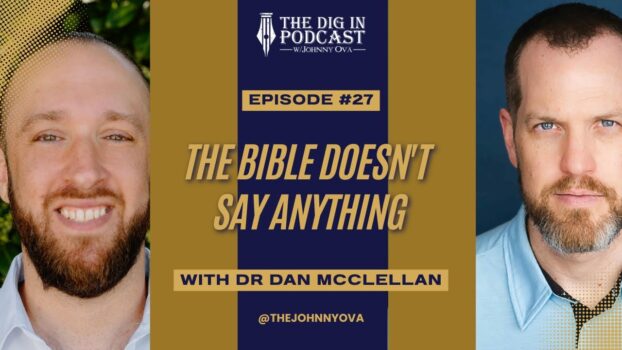
What if everything you’ve been told about what “the Bible says” is wrong?
That’s the bold claim from Dr. Dan McClellan, an Oxford-trained biblical scholar with nearly 1 million followers on TikTok who quit his stable career to fight biblical misinformation full-time on social media.
In this groundbreaking episode of The Dig In Podcast, Dr. McClellan tackles some of the most controversial topics in Christianity with refreshing honesty and deep scholarship. From the real meaning of ancient texts about same-sex relationships to the surprising truth about hell and eternal punishment, this conversation challenges conventional thinking at every turn.
From Scripture Translation Supervisor to TikTok Scholar
Dr. McClellan’s journey is anything but typical for a biblical scholar. After earning degrees from Oxford and Exeter and working for over a decade as a scripture translation supervisor, he made a startling career pivot in 2022.
“I’m quitting my job to argue on the internet for a living,” he told his wife, who understandably had concerns about losing their employer-paid health insurance.
But within months of teaching online classes and creating content on TikTok and YouTube, Dr. McClellan was making more money from social media than his full-time job ever paid him. Why? Because millions of people were hungry for honest biblical scholarship that challenged the misinformation they’d been hearing their entire lives.
Why “The Bible Says” Is Misleading
The most provocative statement Dr. McClellan makes is this: “The Bible doesn’t say anything.”
Before you dismiss this as heresy, hear him out. What he means is that texts don’t have inherent meaning. They’re collections of signs and symbols that readers interpret based on their own context, biases, and predetermined boundaries.
“When people say ‘the Bible clearly says this,’ they’re telling you what THEY decided it means,” Dr. McClellan explains. “Not what it actually says.”
He illustrates this with a hilarious story about trying to order biscuits at a KFC in Oxford, England, only to discover that in the UK, “biscuits” means cookies. The same word, decoded entirely differently based on cultural context.
This isn’t about undermining scripture. It’s about understanding how language actually works and recognizing that interpretation always involves human choices and cultural context.
What the Bible Actually Says About Same-Sex Relationships
One of the most contentious topics in modern Christianity gets a thorough scholarly treatment in this episode. Dr. McClellan explains why asking “what the Bible says about homosexuality” is like asking what Genghis Khan thought about the NFL.
“They had running, they certainly had tackling, they had throwing, they had kicking,” he explains. “They did not have the NFL. It was just a category that didn’t exist.”
The ancient world had no concept of sexual orientation as we understand it today. They thought about sex in terms of power, domination, and social hierarchy rather than mutual love between equal partners.
Understanding this cultural context completely changes how we read passages in Leviticus and Romans. Dr. McClellan breaks down why the ancient prohibitions were about social hierarchy and gender roles, not about the kind of committed same-sex relationships we see today.
The Shocking Truth About Hell
Perhaps most surprising is Dr. McClellan’s research on hell and eternal conscious torment. His conclusion? Most of what we think about hell isn’t even in the Bible.
“Hell as we know it is overwhelmingly a post-biblical creation,” he states. “It’s really a product of medieval Italian literature and public discourse that has gone on since then.”
The Hebrew Bible doesn’t have a concept of hell at all. Everyone just went to Sheol, a murky underworld for all the dead regardless of moral standing. The idea of eternal conscious torment developed gradually and wasn’t systematized until after the biblical period ended.
Dr. McClellan points out that the New Testament actually contains multiple competing views of post-mortem punishment, including annihilationism (ceasing to exist), temporary punishment followed by restoration, and eternal torment. The early church chose eternal torment not because it was the clearest biblical teaching, but because “it was the most rhetorically useful. It’s the most threatening.”
This ties into the recent controversy around Kirk Cameron publicly questioning eternal conscious torment, which Dr. McClellan addresses with both humor and scholarly precision.
The Most Common Biblical Misinformation
When asked about the misinformation he sees most often, Dr. McClellan identifies two major sources:
From Believers: The Presupposition of Univocality
This is the assumption that the entire Bible speaks with one single, unified, consistent voice that cannot contradict itself. Dr. McClellan is clear: “That isn’t supported by any data. That is a dogma people have developed over the millennia as a way to protect their leveraging of the Bible as a source of authority.”
From Non-Believers: The “Bronze Age Goat Herders” Myth
On the other end of the spectrum, critics often dismiss the Bible as “the ramblings of Bronze Age goat herders.” Dr. McClellan corrects this too: not a single word of the Bible was written in the Bronze Age, and the biblical authors were some of the most educated, well-trained people in their societies.
Can You Be Both a Scholar and a Person of Faith?
One of the most common concerns about critical biblical scholarship is whether it destroys faith. Dr. McClellan addresses this head-on.
“You don’t have to believe that every word of the Bible is inerrant to believe that it is inspired,” he explains. “Why can’t it be a catalyst for your own inspiration or guidance?”
The problem isn’t scholarship. The problem is when people use the Bible to structure power and control others rather than to genuinely seek wisdom and connection with God.
Why This Conversation Matters
Dr. McClellan receives overwhelmingly positive feedback from people who say they’ve “never felt like they’ve had permission to think and talk about the Bible and their faith this way.”
This is the freedom that comes from honest scholarship. Not to destroy faith, but to liberate people from rigid interpretations that may have been serving someone else’s agenda rather than genuine spiritual growth.
The misinformation matters because it shapes how we view God, how we treat people, and how we understand our faith. When we mistake human interpretation for divine decree, we can end up defending positions that cause real harm while claiming biblical authority.
Watch the Full Episode
This article only scratches the surface of this fascinating conversation. Dr. McClellan also discusses:
- His journey from being kicked out of college to earning a PhD from Exeter
- Why he fell in love with studying the Gospels as a missionary in Uruguay
- The gap between ivory tower scholarship and what people hear in church
- How TikTok’s algorithm opened the floodgates to biblical scholarship for millions
- The surprising lack of hate mail he receives (and why female scholars have it worse)
- Why people who use the Bible to structure power are most scared of his work
- His upcoming second book: a biography of the God of the Bible
Don’t miss this eye-opening conversation that will change how you read the Bible.
Subscribe and Connect
Never miss an episode of The Dig In Podcast:
- YouTube: Subscribe to The Dig In Podcast
- Apple Podcasts: Listen on Apple Podcasts
- Spotify: Listen on Spotify
Connect with Dr. Dan McClellan:
- TikTok, YouTube, Instagram, Twitter, Blue Sky, Threads: @maklellan
- Podcast: Data Over Dogma (new episodes every Monday)
- Patreon: For online classes and community discussions
- Book: The Bible Says So (tackles controversial biblical topics head-on)
About The Dig In Podcast
The Dig In Podcast features conversations with leading biblical scholars, historians, and archaeologists who challenge conventional Christian thinking by presenting fresh scholarship perspectives. Hosted by Pastor Johnny Ova of Sound of Heaven Church, each episode releases Monday mornings across all major podcast platforms.
Our mission is to make biblical scholarship accessible and exciting for everyday Christians who want to learn without needing a theology degree.