
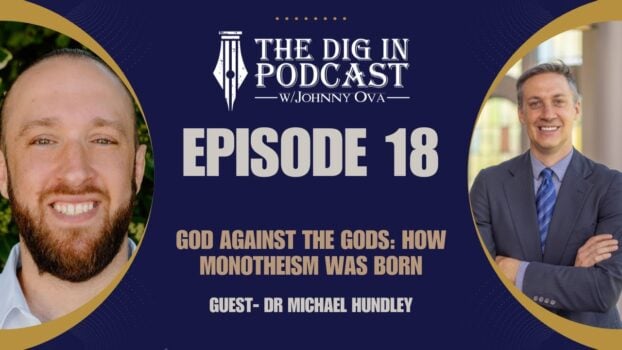
When you open your Hebrew Bible, you’re stepping into a world that looks radically different from what most modern Christians imagine. The ancient Near East wasn’t a landscape of competing monotheisms; it was a vibrant marketplace of gods and goddesses, each with their own specialties, powers, and devoted followers. But somewhere in this crowded divine landscape, something unprecedented happened: ancient Israel developed an exclusive commitment to one God that would eventually reshape how billions of people understand faith, morality, and the divine.
Dr. Michael Hundley, a leading scholar in ancient Near Eastern religion, joined me on The Dig In Podcast to explore one of the most fascinating questions in biblical scholarship: Was Israel always monotheistic, or did their understanding of God evolve over time? His answers challenge many assumptions we bring to Scripture while revealing how the ancient Israelites understood their relationship with Yahweh in ways that might surprise you.
The Religious Landscape Before Israel
A World Full of Gods
Before we can understand what made Israel’s faith unique, we need to grasp what was normal in the ancient world. Dr. Hundley explains that polytheism wasn’t just common; it was universal: “Pretty much everybody out there imagined multiple different gods. That was kind of the universal. We assume that this idea of one God is normal, but it’s actually not. It is an aberration.”
This polytheistic worldview followed a consistent pattern across cultures:
The Divine Hierarchy:
- High God (The CEO figure who administered the cosmos, often not a warrior but a judge and creator)
- Major Gods (Cabinet members with specialized powers like storm, fertility, war)
- Minor Gods (Support staff serving the major deities)
- Wild Gods (Peripheral beings including monsters, rivers, diseases, and natural phenomena)
Understanding this hierarchy is crucial for biblical interpretation because Israel’s scriptures were written in dialogue with this existing religious framework, not in a vacuum.
Why Did People Believe in Multiple Gods?
Dr. Hundley introduced a fascinating concept from cognitive science of religion called the “hypersensitive agency detection device.” Essentially, humans are wired to assume there’s an intentional agent behind unexplained phenomena as a survival mechanism.
“If I’m back in the Serengeti hunting and the grass rustles, is it a lion or is it the wind?” Dr. Hundley explained. “Chances are it’s the wind or another animal that’s not a predator, but I am predisposed to assume it’s a lion.”
This biological predisposition, combined with what scholars call “theory of mind” (our tendency to project human-like consciousness onto the world), created the perfect conditions for polytheistic belief systems. When ancient peoples faced the uncertainties of rain, harvest, disease, and war, believing in gods who were “like me” offered something crucial: the possibility of influence.
The practical logic was compelling: If rain just happens randomly, I’m helpless. But if there’s a rain god who thinks and wants things like I do, then I can serve him, worship him, and potentially receive rain in return. As Dr. Hundley put it: “The more unlikely it is, the more likely we are to assume that there is an agent behind it, a creator who is like me.”
The system was self-reinforcing. “If it doesn’t rain then I must have done something wrong and the God is mad at me,” Dr. Hundley explained. “So I got to redouble my efforts or maybe I’m praying to the wrong God…the stakes are high enough that I’m gonna believe it no matter what.”
How Different Was Israel’s Faith?
The Shocking Truth About Early Israelite Religion
Here’s where Dr. Hundley’s scholarship challenges many assumptions. When asked if ancient Israel’s view of the divine was radically different from their neighbors, his answer might surprise you: “I think this is something that a lot of people don’t understand. The Bible just sort of didn’t fall out of the sky in King James English. It was written in a context with people who understood the world the way their neighbors did.”
Key evidence that early Israelites acknowledged other gods:
- The Bible mentions the word “god” hundreds of times and “almost never says other gods don’t exist”
- Phrases like “God of Abraham, Isaac, and Jacob” wouldn’t need specification if Yahweh were the only god
- The divine council described in Scripture assumes other divine beings
- Commands to worship Yahweh exclusively imply the existence of alternatives
- The constant warnings against worshipping “foreign gods” presuppose their existence
Dr. Hundley explains: “What they’re trying to say generally is, you don’t need them because I’m enough. Even in the context of Genesis and Exodus, you say like, I’m the God of Abraham, Isaac, and Jacob. If they believed he was the only God, they wouldn’t need to specify.”
Angels, Cherubim, and the Divine Council: Were They Gods?
This brings up a fascinating question that Dr. Hundley addresses head-on: What about all those supernatural beings in the Bible? By ancient Near Eastern standards, many of these beings probably were gods.
“You know, the word son of God, people will often interpret that in a different way,” Dr. Hundley noted. “Son of God just means God, right? So Ezekiel gets called son of man, which simply means he’s a man. And you have this idea that the host of heaven, the divine council, even cherubim, seraphim, so many different characters and angels we assume are not gods, usually because we assume there’s only one God, which is kind of…we’re kind of assuming our solution before we even look at it.”
The Divine Council appeared throughout ancient Near Eastern cultures as a gathering of divine beings who met with the high god to make decisions. “Just like humans, when they’re making a decision, they meet,” Dr. Hundley explained. “And the high god at the end of the day is the one who makes the decision and decides this is what we’re going to do. But they take counsel.”
This wasn’t unique to Israel. The Ugaritic texts from before the Bible was written show El as the high God with major and minor gods beneath him. “The biblical world is very much like that,” Dr. Hundley said. “Based on all the parallels we know, the ancient people would have imagined the world, even the world that they believed in, full of multiple different gods.”
Monolatry vs. Monotheism: The Game-Changing Distinction
This brings us to perhaps the most important concept in understanding ancient Israelite religion: monolatry versus monotheism.
Monotheism = Belief that only one God exists Monolatry = Exclusive worship of one God while acknowledging others exist
Dr. Hundley uses a brilliant analogy: “The way I explain this to my students basically is it’s like a marriage, right? So I recognize the existence of other women out there. I’m not saying they don’t exist. What I am saying though is I have this exclusive commitment to my wife, so she’s the only woman for me. And that pretty much is the direction the Bible goes.”
This distinction is critical because it explains so much about Old Testament theology that otherwise seems confusing:
Why the constant warnings against other gods? Because they existed and were genuine temptations.
Why the fierce opposition to Baal worship? Because Baal was competition for exclusive commitment, not for supremacy.
Why angels don’t get names until late in biblical history? Because early on, named divine beings could become objects of worship.
The Three-Step Process to Exclusive Worship
Dr. Hundley outlined a fascinating three-step process that made monolatry work:
Step One: God Has to Be Everything
“If you are defending exclusive worship, this God has to offer absolutely everything,” Dr. Hundley explained. “Because if I can’t deal with childbirth, then you’re gonna go to the goddess of childbirth when that comes up, right?”
This is actually harder than just being “king of the gods.” A king of the gods can have limitations. But a God demanding exclusive worship? He has to meet every need. “The way the text presents him is also very interesting because he doesn’t really have a backstory…he kind of just is. And so he’s unknown, which makes him pure potential. So he can be whatever the text needs him to be.”
Step Two: The Non-Compete Clause
“If you want me to be your God, it’s got to be only me,” Dr. Hundley said. “So you got to pick me or the field, which is basically like imagine Amazon saying, if you want to shop at Amazon, you got to not shop anywhere else.”
This exclusivity requirement was radical. In most ancient religions, mixing and matching gods was perfectly normal. “If my favorite grocery store is Whole Foods, it’s not like I’m gonna, Whole Foods doesn’t carry what I’m looking for…I’m gonna go to another store. And that is typically how we do religion too.”
Step Three: Eliminating the Competition
“You’re pushing the other gods out of the market,” Dr. Hundley explained. Take Baal, for example. “He’s a local storm god. And you’re coming to get this land, you need rain. He’s a local guy…So you spend a ton of time pushing him out of the market and saying…he’s nothing, doesn’t have any powers, but they never actually say he’s not a God. They’re just basically saying, he’s nothing compared to me.”
The conflict wasn’t cosmic. God was always in charge. The conflict was over human worship and commitment.
How Angels Became “Not Gods”
One of the most fascinating parts of our conversation dealt with how biblical theology handled minor divine beings. Dr. Hundley explained that the text uses a clever strategy: “Angels don’t get names. These beings don’t have any names. All they have, they basically wear the Yahweh.com name tag…There is nothing about them that we know that we can grab ahold of. They are basically just a conduit to their employer.”
The word “angel” literally just means “messenger.” It’s not describing what they are but what they do. “Effectively what you end up doing is you give this minor God category a name and that name is angel…In the system that’s acceptable, you have God and angels, which effectively means you have only one God.”
When did this shift happen? Dr. Hundley points to Daniel 3:24-28 as possibly the first instance where these beings get classified as “angels.” In the story of Shadrach, Meshach, and Abednego in the furnace, there’s “one that looks like a son of God” but later the text says “God sent his angel or messenger.”
Once this category was established and these beings were no longer competition, they could get names and identities. “Why do angels get names and identities?” Dr. Hundley asked. “They’re not competition anymore…Now we’ve established that in the system there’s only one God. And as a result of that, you can have some critical distance.”
What about foreign gods? They got reclassified too. “If it’s a being who’s not on Team God, then it is a demon,” Dr. Hundley said. “So today, any god who is not the god is either a demon, not real, or a distortion of the one true god.”
And where did demons come from? They became fallen angels. “God created everything. So God must have created them…They chose to rebel. And then what category are they in? The only category left is angels.”
War, Exile, and the Evolution of Faith
Written by Losers, Not Winners
Dr. Hundley made a striking observation: “This is also something about the Bible that’s really interesting because usually you hear that the history is written by the winners, but this is written by the losers.”
Israel’s history was one defeat after another:
- Assyria knocked out the Northern Kingdom
- Babylon sent them into exile
- They were constantly under the thumb of larger empires
This created a theological crisis. “On the face of it…Babylon and Assyria basically say is, your God’s weaker than mine. How do I know? I beat you. So why would you still worship that God?”
Most conquered peoples assimilated. “From the ancient world, this is really the only living religion left” that didn’t assimilate, Dr. Hundley noted.
The Weaker Israel Got, The Stronger God Had to Be
Here’s the paradox: “Israel gets weaker and weaker, and they can’t do much. And as a result of that, in order to justify exclusive worship, God has to be stronger and stronger. So the weaker Israel gets, the stronger God has to be.”
They were facing universal gods like Marduk of Babylon, Amun of Egypt, and Ashur of Assyria. These were gods of empires, “one-stop-shop” gods. “In order to justify exclusive worship, you have to convince people that Yahweh is still worth worshiping exclusively. So he takes on this universal role, where he is bigger and better than they are.”
The Problem of Evil and the Blame Game
With only one God in charge, a new problem emerged: “Effectively in this system, there’s only one supernatural power. And what that means is everything that happens is his responsibility. So either he allows it or causes it.”
This created what we now call the problem of evil. Before, when you had multiple gods, you could blame different deities for different problems. But with one God? “You have to explain how does this one God of the universe allow all this stuff to happen, right?”
The solution in the Hebrew Bible was to blame themselves. “What went wrong is we were not true to the covenant. We didn’t follow our end of it. And God is punishing us for that. So you’ve got to convince people that this happened not because our God is weaker, but because our God is punishing us.”
But punishment couldn’t be the end. “You’ve got to convince people that punishment isn’t the end, that there’s some sort of redemption…the suffering is going to be worth it.”
Projecting Hope Into the Future
“When you have no hope in the present, when you are under the thumb of a bigger empire, you tend to project your hope into the future,” Dr. Hundley explained. “And God makes bigger and bigger promises in order to keep the worship going.”
Jewish tradition developed the concept of redemptive suffering for the people collectively. If they suffered enough, it would bring about the Messianic age.
Christianity interpreted this as the suffering of an individual (God himself) for the group.
Islam offered yet another interpretation.
All three traditions agreed on the core narrative: God made promises, Israel was weak and not realizing them, they screwed up. “The question then is where does redemption come from? And that is where those all three of them kind of split up a bit.”
The Rise of Exclusivity and Its Radical Implications
Why Ancient Exclusivity Was So Offensive
The monolatry of Israel (and later the monotheism of Christianity and Islam) created something deeply offensive to the ancient world. Dr. Hundley explained the Roman perspective: “They called early Christians atheists, not because they didn’t believe in God, but because they rejected the gods that everyone else believed in.”
When Christians refused to offer incense to Caesar, Romans were baffled. “You guys think you’re so special, why won’t you just bend the knee? Everyone else does it…You can worship your god, but worship ours too. That’s just how society works.”
Religious exclusivity wasn’t normal. It wasn’t expected. It was, frankly, annoying. “A lot of other religious traditions, it’s like, well, I’ll go to your church and do your thing, but you don’t come to mine. What’s wrong with you? Because it’s kind of normal that we share, but this idea of exclusivity really is separate.”
The Birth of Evangelism
Most world religions don’t evangelize. Why would they? “You can believe whatever you want,” Dr. Hundley noted. “I got my gods, you got your gods. So what do I need your gods for?”
Gods were often cultural. “The God of Israel is the God of Israel. I’m not Israelite, so not my God.”
But something changed with the claim of universal truth. “When you have monotheism, you have this claim of absolute, right? So this is THE God and this one God does have all of the answers. And when that happens, you have to spread it.”
Three religions evangelize: Christianity, Islam, and Buddhism. “All three of them believe that they have the answer to the question…they believe they have exclusive truth. And that is why they feel like they need to get more numbers.”
Dr. Hundley emphasized this isn’t sinister: “It’s not like, hey, we’re trying to build this evil empire and twist our mustache. It’s like the little old lady wants to save you so you can join her team and get the benefits and not the punishment.”
Jewish Exclusivity Without Evangelism
Early Judaism took a different approach. “The Jewish understanding was…we’re going to be a blessing to the nations. The idea is we’re going to be this great people who’s going to show off our great God and people are going to come to us.”
They weren’t going out to convert. You could join, but you had to become Jewish first. “If you want to worship my God, you got to become one of my people.”
This created the famous conflict between Peter and Paul: “Do you have to follow the Jewish law? Do you have to become Jewish to become a Christian? Or can you just jump the line?”
The Jewish perspective made sense: “We have been surviving as this people. We’ve been faithful as much as we can. We’re still here. And these other guys who don’t know anything at all don’t have to understand our suffering, don’t have to follow our culture. And they can just jump up to the line and get Jesus to give them all these great things. Not fair.”
First-Century Jewish Beliefs About God
I asked Dr. Hundley a critical question: In the first century, did the Pharisees and high priests believe other gods existed, or were they truly monotheistic?
His answer is revealing: “We don’t have any literature that says they said it was the only God, really, or not anything early, exactly.”
While later literature does make this claim, around the time of Jesus, evidence is scarce. “If I were to guess, I would say they probably acknowledge the existence of other gods, but they assume that theirs was superior and theirs was worth worshipping exclusively.”
This didn’t mean they wanted Gentiles worshiping Yahweh without becoming Jewish. “We got the best God. Is he the only one? Well, doesn’t spell it out, but whatever is out there is inferior and it’s not really worth talking about. But my God’s great and I’m going to show him off and people can come to me and have what I have, but I’m not gonna go out and advertise.”
How This Transformed World Religion
The Gift of Coherence Over Truth
Dr. Hundley made a fascinating observation: “As humans, we’re interested more in coherence than we are in truth…One thing that religion does is it brings coherence to our world. The world’s big, the world’s scary, and religion helps to explain it.”
Ancient Israelite theology wasn’t primarily about getting numbers. “The goal is depth, not…quantity as quality over quantity…The idea of getting as many people to worship as possible really wasn’t a goal.”
But what made it work? “Whether it’s true or not is a different question. But I think what makes it so powerful is they pitched it in a way that people wanted…it really speaks to the human condition in a way that goes across ages and times. So it did resonate with them enough because they survived, and it resonates with us because we’re still talking about” it.
Universal Morality: A Revolutionary Concept
“With the morality too, you also have this concept…this idea that there is a universal morality,” Dr. Hundley explained. “Instead of you having your cultural customs and me having mine and there being some sort of philosophical greater good, there is a divinely given set of rules that applies to everybody. And that is, that’s a game changer.”
This concept appears primarily in Judaism, Christianity, Islam, and to some extent Buddhism. It’s fundamentally different from the cultural relativism of most ancient religions.
The Western World and Christian Assumptions
“Whether you’re Christian or not growing up here you are very…you grew up in a world that was imbued with these Western Christian ideas,” Dr. Hundley noted. “Like even if you’re anti-god you’re usually anti-god because He’s not like what people say the Christian God should be so we tend to define everything through that lens.”
The impact extends even to scientific advancement. “In the Western world, a lot of scientific advances come because people believe there was a god in charge and there was an ordered world. So with that, this gives definitive answers that other traditions don’t.”
The downside? “As a result of that, it often doesn’t always play well with others.”
The One Thing Every Christian Should Understand
I asked Dr. Hundley: If you could clear up one modern misconception about ancient Israel’s faith, what would it be?
His answer was clear: “Not monotheism, monolatry. Exclusive worship, that is…if you’re looking at what sets Israel apart from everybody else, exclusive worship.”
He elaborated: “The idea of this God making a contract with his people for exclusivity, that’s the game changer. And in my mind, monotheism wasn’t the goal, but was sort of an effect of having to promote monolatry.”
Why Labels Matter (and Don’t)
Dr. Hundley posed a challenging question: “Why does it matter? Why does it matter what we call it? So whether we believe there’s only one God…what’s the difference between one God and a bunch of…one high God and a bunch of minor gods, and one God and a bunch of angels? Other than definition, right?”
The honest answer? “We’re much more comfortable with” calling them angels rather than gods. But functionally, what’s the difference?
“Because again, that’s about coherence. We want the system that makes sense, and we explain it in a way that makes sense to us. Everybody wants to believe that their tradition is the right one…our system encompasses the entire world, and we’re right. Is that true? I don’t know, but it is comforting.”
Practical Applications for Pastors and Christians
Read Scripture in Its Historical Context
Understanding that ancient Israel developed their theology in dialogue with polytheistic cultures helps us read the Old Testament more accurately. When you see warnings against other gods, references to the divine council, or descriptions of supernatural beings, you’re seeing real theological wrestling with exclusive commitment in a world full of religious options.
Recognize the Radical Nature of Christian Exclusivity
Monolatry was offensive in the ancient world for good reason. It demanded total commitment in a culture where religious shopping was normal. When we face pressure today to be “more inclusive” or to treat all religious paths as equally valid, we’re experiencing the same tension ancient Israel faced.
Understand Why We Believe What We Believe
Many Christians accept traditional theology without understanding how it developed. Knowing that concepts like fallen angels, demons, and the problem of evil emerged as Israel wrestled with maintaining exclusive worship of one God helps us engage these doctrines more thoughtfully.
Appreciate the Journey of Faith
Biblical theology wasn’t downloaded fully formed. It developed through suffering, defeat, exile, and theological reflection. This should give us permission to wrestle with hard questions about God and Scripture rather than demanding easy answers.
Engage Scholarship Humbly
As Dr. Hundley reminded us: “We’re not really proving things…We’re just doing guesswork like everybody else. We’re taking the data we have and making the best cases we have. So this is an ongoing process. It’s a dialogue.”
Christian faith doesn’t require certainty about every historical detail. It requires commitment to following Jesus in light of the best understanding we can achieve.
Warning Signs and Red Flags
Don’t Flatten Biblical Theology
Modern Christianity often reads later theological developments back into earlier texts. When we assume the Old Testament teaches full-blown monotheism from Genesis 1, we miss the theological journey actually recorded in Scripture.
Don’t Ignore the Divine Council
Many Christians are uncomfortable with passages that suggest other divine beings. Rather than explaining them away, we should wrestle with what ancient Israelites actually believed and how their exclusive worship of Yahweh functioned in that context.
Don’t Weaponize Exclusivity
Yes, biblical faith demands exclusive commitment. But this doesn’t mean treating other religious traditions with contempt or refusing to learn from scholarship. The goal is depth and transformation, not numbers and superiority.
Future Implications: Where Do We Go From Here?
Recovering Ancient Wisdom for Modern Faith
Understanding monolatry versus monotheism opens new possibilities for biblical interpretation. It helps explain why certain passages seem to acknowledge other gods while simultaneously demanding exclusive worship of Yahweh.
Engaging Academic Scholarship
Dr. Hundley’s work represents the kind of rigorous biblical scholarship that enriches rather than threatens faith. His forthcoming book “Ancient Gods and Monsters” (expected approximately a year from now) will explore how ancient cultures constructed their worldviews and what that reveals about how we construct heroes and villains today.
Public-Facing Scholarship
Dr. Hundley recently published a four-part series with Ancient Near East Today covering:
- What is God in the Ancient Near East?
- What is God in the Hebrew Bible? (two parts)
- From Monolatry to Monotheism
These articles are written for non-academics and provide an accessible entry point into his arguments.
Continuing the Conversation
The questions Dr. Hundley raises aren’t meant to undermine faith but to deepen it. How does understanding ancient Israelite religion in its original context help us follow Jesus more faithfully? What does it mean to maintain exclusive commitment to Christ in a pluralistic world? How do we hold strong convictions while remaining humble about the limits of our knowledge?
Watch This Eye-Opening Conversation
Don’t miss this fascinating exploration of how ancient Israel revolutionized religion through their radical commitment to exclusive worship. Dr. Hundley’s expertise in ancient Near Eastern religion combined with his accessible teaching style makes complex scholarship come alive.
Subscribe to The Dig In Podcast YouTube channel at https://www.youtube.com/@thejohnnyova to catch this full conversation and dive deeper into the historical context that shaped biblical faith.
Connect With Dr. Michael Hundley
Dr. Hundley’s work bridges academic scholarship and public understanding of ancient religion. His four-part series with Ancient Near East Today offers an excellent introduction to his research on gods in the ancient Near East, gods in the Hebrew Bible, and the transition from monolatry to monotheism. These articles are specifically written for general audiences rather than academic specialists.
His forthcoming book “Ancient Gods and Monsters” promises to explore the fascinating overlap between divine beings and monstrous creatures across cultures, examining how ancient peoples constructed their worldviews and what that reveals about how we create heroes and villains today.
Stay Connected With The Dig In Podcast
Want to continue exploring the Bible through deep conversation, historical context, and scholarly insight? Here’s how to stay connected:
Subscribe to our YouTube channel: https://www.youtube.com/@thejohnnyova for full episodes and bonus content that helps Christians engage Scripture with greater depth, clarity, and curiosity.
Follow all things Johnny Ova: https://linktr.ee/johnnyova for updates, resources, and ways to support this ministry of biblical education.
Read Johnny’s book: The Revelation Reset offers a preterist perspective on biblical prophecy and the events of 70 AD. Available at https://a.co/d/hiUkW8H
The Dig In Podcast exists to help pastors, church leaders, and engaged Christians discover the richness of Scripture in its historical and cultural context. Every episode brings scholarly expertise into accessible conversation, challenging conventional interpretations through rigorous research while maintaining deep respect for the life-transforming power of God’s Word.